Introduction: The Long Story Behind a Human Question
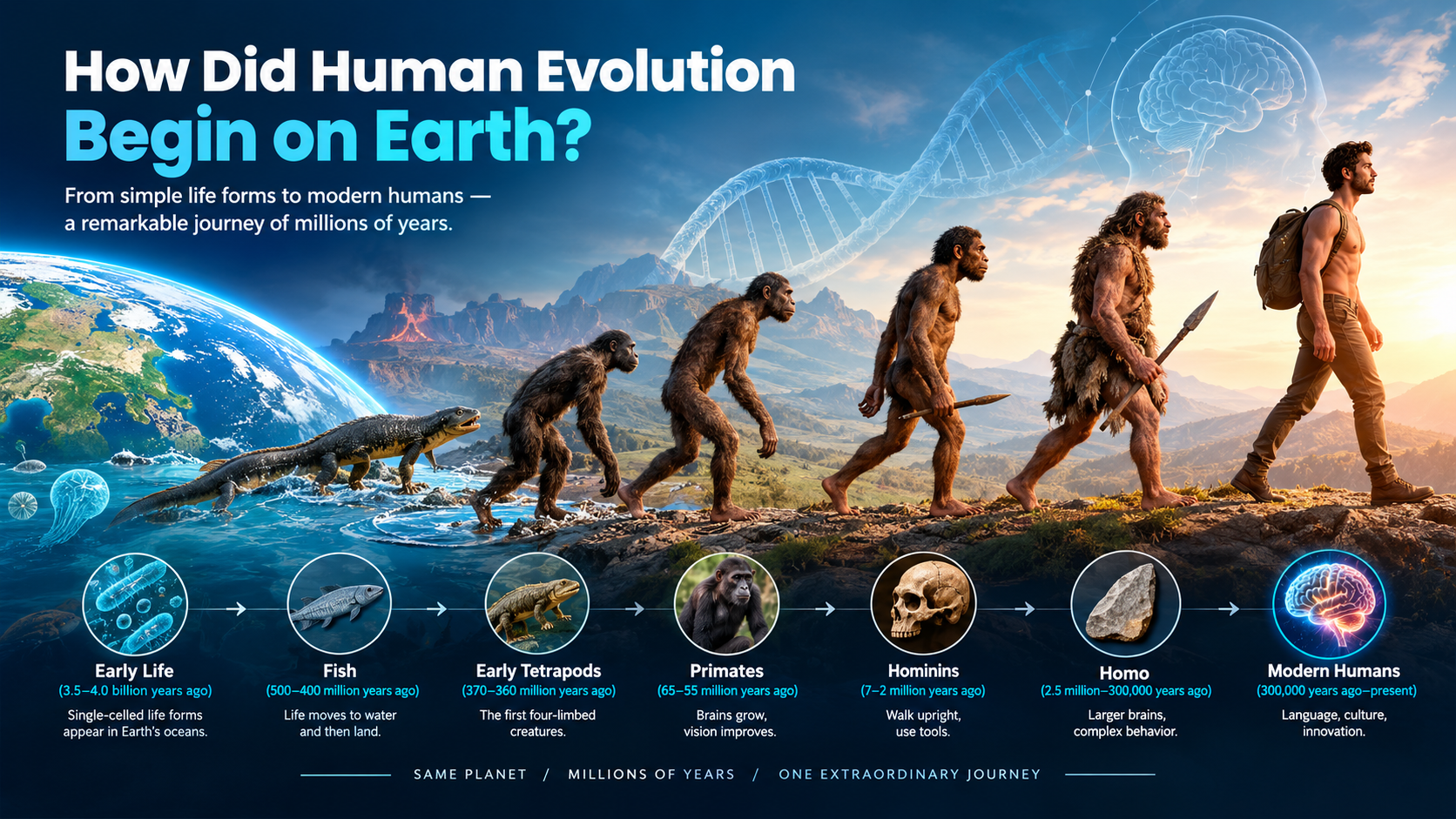
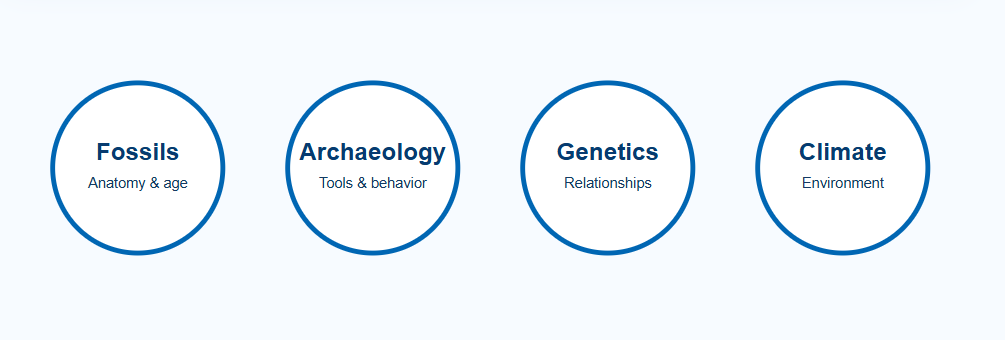
Human evolution is the scientific history of how populations in the human lineage changed across millions of years and eventually produced Homo sapiens. It did not begin with a single individual who suddenly became human. It was a branching process involving many populations, species, migrations, environmental changes, genetic variation, natural selection, learning, and cultural innovation.The human lineage is much older than our own species. Scientists generally place the split between the lineage leading to humans and the lineage leading to living chimpanzees and bonobos somewhere around six to nine million years ago, although the exact date remains uncertain. By contrast, the oldest widely accepted fossils of Homo sapiens are about 300,000 years old. Between those points lies a long history of extinct hominins.Fossils provide evidence about bodies; archaeology provides evidence about behavior; genetics provides evidence about relationships; and geology and climate science provide evidence about environments and time. No single fossil or artifact explains the entire story. The most reliable conclusions come from several independent kinds of evidence pointing in the same direction.A useful way to understand human evolution is to abandon the idea of a ladder. Evolution is not a march from primitive to advanced. It is a branching family tree. Several human species existed at the same time, and most eventually disappeared. Homo sapiens is simply the only human species that remains today.Modern research also emphasizes uncertainty. Scientists have strong evidence that humans evolved in Africa and that bipedalism is millions of years old. At the same time, researchers continue to debate the exact relationships among some early hominins, the precise routes of ancient migrations, and how different biological and cultural changes interacted.
1. Our Place Among the Primates
Humans are mammals and members of the order Primates. Our closest living relatives are chimpanzees and bonobos, followed by gorillas and orangutans. Similarities in DNA, anatomy, development, and behavior show these relationships. The important point is that humans did not descend from any living ape. Humans and living apes inherited different branches from older shared populations.The common ancestor of humans and chimpanzees has not been identified with certainty as a particular fossil. The earliest part of the human branch is represented by a small number of fossils whose anatomy can be difficult to interpret. Sahelanthropus, Orrorin, and Ardipithecus are especially important because they occur near the time when the human lineage was developing distinctive traits.Early hominins lived in Africa, where landscapes changed repeatedly. Forests, woodland, open habitats, lakes, rivers, and seasonal environments could occur close to one another. This ecological mosaic matters because early human ancestors did not simply move from a forest world into a permanent grassland world. Their environments were dynamic.Evolution works with inherited anatomy. A new trait usually develops by modifying structures that already exist. The pelvis, spine, knee, ankle, and foot of humans therefore contain a mixture of adaptations for upright walking and historical features inherited from earlier primates. This is one reason the transition to bipedalism took millions of years.The fossil record from this period is incomplete. A missing fossil does not mean a missing species, and a discovered fossil does not automatically represent a direct ancestor. Scientists use anatomy, dating, geography, and evolutionary models to estimate relationships, and those estimates can change as new evidence appears.
2. The Beginning of the Human Branch
One of the earliest candidates for the human branch is Sahelanthropus tchadensis, known from Chad and dating to roughly six to seven million years ago. Its skull combines features that have been interpreted as human-lineage traits with features that remain difficult to classify. Debate about its femur and locomotion illustrates how uncertain the earliest part of human evolution remains.Orrorin tugenensis, discovered in Kenya, lived around six million years ago. Its thigh-bone anatomy has been interpreted as evidence for some form of bipedal movement. Ardipithecus ramidus, around 4.4 million years old, provides a later example of a hominin capable of upright walking while still retaining adaptations for climbing.These fossils demonstrate that the human lineage did not instantly become a modern human. Early hominins combined traits. They could use the ground while retaining climbing abilities, and they had relatively small brains compared with modern humans. The appearance of one human characteristic did not require all the others to appear at the same time.The term hominin is useful because it avoids forcing every fossil into a simple ancestor-descendant sequence. Scientists can identify organisms that belong near the human side of the primate family tree while still leaving their exact position open to revision. This is especially important for fossils close to the human-chimpanzee split.The earliest stage of human evolution therefore begins with populations that were still strongly connected to the anatomy and ecology of other African apes. Over many generations, some populations developed increasingly effective upright locomotion. That change became one of the defining foundations of later human evolution.
3. Why Did Humans Begin Walking Upright?
Bipedalism is one of the most recognizable human traits. Humans can walk efficiently on two legs for long periods, and our skeleton contains a set of adaptations that support this movement. These include changes in the position of the spine, shape of the pelvis, angle of the femur, structure of the knee, alignment of the foot, and orientation of the skull.Scientists do not have one universally accepted explanation for why bipedalism evolved. Possible advantages include energy-efficient travel, carrying food or infants, reaching while standing, freeing the hands for manipulation, and moving through changing environments. Different advantages may have mattered at different stages.The human pelvis is shorter and broader than the pelvis of a typical chimpanzee, helping stabilize the body during single-leg support. The femur angles inward toward the knee, placing the feet under the body’s center of gravity. The foot has a strong arch and a big toe aligned with the other toes rather than widely separated for grasping branches.Early bipedalism was not identical to modern walking. A species could be capable of upright movement while retaining strong climbing abilities. The evidence suggests that early hominins passed through a long period in which terrestrial walking and tree climbing were both important.Footprints are especially valuable because they record actual movement. The Laetoli footprints in Tanzania, dating to about 3.6 million years ago, provide strong evidence that early hominins were walking upright long before the appearance of Homo sapiens.
4. Australopithecus and Lucy
Australopithecus is a group of extinct African hominins that lived millions of years ago. Australopithecus afarensis is among the best known because it includes the partial skeleton called Lucy, discovered in Ethiopia in 1974. Lucy lived about 3.2 million years ago and preserves a combination of ape-like and human-lineage characteristics.Lucy had a small brain compared with modern humans, yet her pelvis and lower limbs show adaptations for upright walking. Her anatomy demonstrates that a human-like mode of locomotion evolved before the large brain that is often associated with modern humans.Lucy was not a modern human in miniature. Her arms and hands retain features associated with climbing, while her lower body was well suited to bipedal movement. This combination supports the view that early hominins lived flexible lives in environments where both ground travel and climbing could be useful.Other australopithecine species show that human evolution involved multiple experiments. Some had relatively generalized anatomy, while robust forms traditionally placed in Paranthropus developed powerful chewing systems and large teeth. These lineages survived for long periods but eventually disappeared.The major lesson of Australopithecus is that human traits evolved at different times. Walking upright is ancient; large brains are much later. Toolmaking, symbolic behavior, complex language, agriculture, and cities are later still. Human evolution is a sequence of interacting changes rather than one dramatic transformation.
5. The Rise of Early Homo
The genus Homo appears in Africa roughly 2.5 to 2.8 million years ago, although the exact earliest species and the boundaries of the genus are debated. Homo habilis has traditionally been associated with early Homo, but the relationship between specific fossils and specific archaeological technologies remains an active research question.Stone tools are among the earliest major archaeological signs of a changing human way of life. A sharp stone flake could cut meat, process plants, scrape hides, and modify wood. Toolmaking expanded the range of materials that hominins could exploit and created a new dependence on learned technical behavior.Oldowan technology is often described as simple because the tools are visually uncomplicated. Yet producing a useful flake requires selecting an appropriate stone, orienting it, controlling force, and learning from repeated attempts. Archaeologists study fracture patterns and wear to distinguish intentional manufacture and use from natural breakage.Early Homo also shows changes in body proportions. Later Homo populations, especially those associated with Homo erectus, had longer legs and more human-like proportions. These features would have supported efficient terrestrial travel and may have helped populations exploit larger geographic areas.Human evolution did not follow a rule in which bigger brains automatically produced every later adaptation. Different traits appeared at different times. Some technologies existed before substantial brain expansion, while some body changes occurred before sophisticated symbolic behavior. Evolution assembled the human package gradually.
6. Fire, Food, and Technology
Fire is one of the most important technologies in human prehistory, but the archaeological evidence must be evaluated carefully because natural fires can produce burnt materials. Stronger evidence for repeated fire use becomes common in later Pleistocene contexts. Fire could provide warmth, light, protection, and a means of processing food.Cooking can soften food, change its texture, reduce some pathogens, and make certain nutrients easier to obtain. It may also reduce the time needed for chewing and digestion. However, cooking should not be treated as the single cause of human brain expansion. Brain evolution involved many interacting biological, ecological, demographic, and cultural factors.Animal bones sometimes preserve cut marks made by stone tools. These marks can help researchers reconstruct butchery and carcass processing. Stone tools can also preserve microscopic wear. By combining these clues with animal ecology and site context, researchers can estimate how early humans obtained and processed food.Food availability influenced mobility. If resources were seasonal or scattered, groups needed strategies for tracking, collecting, storing, sharing, or replacing foods. Human cultural learning allowed communities to preserve information about landscapes and seasonal cycles across generations.Technology became part of the human ecological niche. A handaxe, spear, shelter, clothing system, or cooking technique changes the relationship between a body and its environment. Humans increasingly survived not only because of anatomy but because knowledge could be stored socially and passed from one generation to the next.
7. Homo erectus and Expansion Beyond Africa
Homo erectus and closely related early Homo populations represent a major stage in human evolution. Their body proportions were more similar to those of later humans, with relatively long legs and shorter arms. Fossils and archaeological evidence indicate that early humans expanded beyond Africa by roughly 1.8 million years ago.The Dmanisi site in Georgia preserves human fossils dating to about 1.77 million years ago and provides some of the earliest evidence of humans outside Africa. The site demonstrates that early Homo populations could occupy Eurasian environments much earlier than the emergence of modern humans.Migration did not mean that one group walked out of Africa and continuously expanded without interruption. Early dispersals could fail, populations could disappear locally, and later groups could occupy the same regions. Human movement was a repeated process shaped by climate, resources, geography, and population history.New environments created new challenges. Eurasia included seasonal climates, colder regions, unfamiliar animals, and different vegetation. Technology, social cooperation, fire, clothing, shelters, and flexible diets helped early humans expand their ecological range.Homo erectus and related populations also show that evolutionary success can persist for very long periods. Some early human lineages lasted for hundreds of thousands of years. Their eventual extinction does not mean they were poorly adapted; extinction is influenced by changing environments, demography, competition, disease, chance, and interactions among many factors.
8. Neanderthals and Denisovans
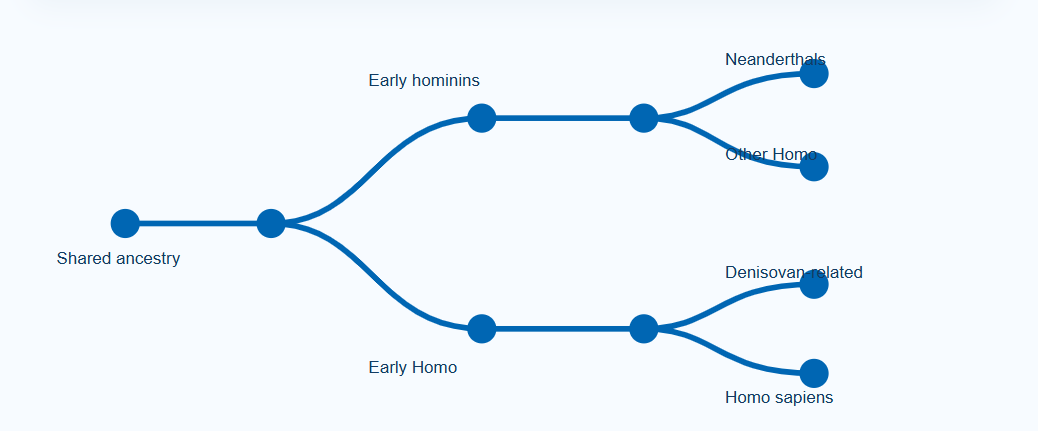
Neanderthals lived mainly in Europe and western Asia and were close evolutionary relatives of Homo sapiens. Their fossils show large brains and robust skeletons. Archaeological evidence includes sophisticated stone tools, hunting activities, use of fire, care for injured individuals, and other behaviors that show substantial ecological and social competence.Denisovans were identified largely through ancient DNA. This was a major breakthrough because genetics revealed a human population that was not obvious from the traditional fossil record alone. Denisovan-related ancestry survives in some modern populations, especially in parts of Asia and Oceania.Ancient genomes show that Neanderthals and Homo sapiens interbred. Many people with substantial non-African ancestry carry a small percentage of Neanderthal-derived DNA. The exact amount varies among populations, and individual genetic segments can have different histories.Gene flow means human evolution included both separation and connection. Populations could diverge for long periods and later meet again. When they did, some genes crossed population boundaries. Some inherited variants may have been neutral, while others could influence biological responses to local environments.The existence of Neanderthals and Denisovans also changes the way we think about human uniqueness. Homo sapiens was one member of a larger human family. For much of our history, several human populations occupied Earth at the same time.
9. How Homo sapiens Emerged in Africa
The oldest widely accepted Homo sapiens fossils currently known include remains from Jebel Irhoud in Morocco, dated to about 300,000 years ago. These fossils are especially important because they combine a relatively modern face with a more elongated braincase. The mixture suggests that modern human anatomy evolved gradually.Other early Homo sapiens fossils come from eastern and southern Africa. Their differences in skull shape and other traits indicate substantial variation among early populations. Instead of one small population producing all modern anatomy in one location, evidence increasingly supports a model involving multiple connected African populations.This model is sometimes described as pan-African. Populations could become separated by deserts, forests, rivers, mountains, or changing climate. During wetter periods, routes could open and populations could meet. Genes, tools, and cultural practices could then move between regions.The result was not a single moment when everyone suddenly became anatomically modern. Different features appeared at different times. The modern human face, skull shape, body proportions, and other traits accumulated across a long evolutionary process.Genetic evidence supports Africa as the deep source of our species. African populations contain high levels of genetic diversity, consistent with a long history on the continent. Modern genetic patterns, however, have also been shaped by later migration, bottlenecks, gene flow, and natural selection.
10. Climate and Human Evolution
Climate change repeatedly reshaped the landscapes in which early humans lived. Rainfall, temperature, vegetation, lakes, rivers, and deserts changed over thousands and millions of years. A place that is arid today could have supported productive wetlands during a wetter period.Researchers increasingly study environmental variability rather than assuming a simple transition from forest to savanna. Human ancestors occupied mosaics of habitats. The ability to use different foods, travel between habitats, and change behavior could have been valuable in an unstable environment.Climate could also open and close migration corridors. The Arabian Peninsula, for example, has experienced periods when rainfall created lakes and greener landscapes. Such intervals may have made movement between Africa and Eurasia easier than it would be during extremely dry periods.Paleoclimate reconstruction uses lake sediments, pollen, animal fossils, cave deposits, isotope chemistry, and climate models. These sources can reveal vegetation, rainfall, temperature, and water availability. Archaeological evidence can then be compared with the environmental record.Climate should not be treated as a universal explanation for every evolutionary change. Human populations actively changed their environments through technology and cooperation. A strong explanation therefore connects climate, ecology, demography, behavior, and biology rather than assigning everything to one factor.
11. The Major Out-of-Africa Expansions
Homo sapiens reached regions outside Africa more than 100,000 years ago. Fossils and archaeological sites in the eastern Mediterranean demonstrate that early modern humans were capable of leaving Africa long before the later expansion that contributed most of the ancestry of living non-African populations.These earlier movements may have been temporary, local, or only partly connected to later populations. Human dispersal therefore happened in waves. Some groups survived for long periods and disappeared; others left descendants that became major parts of later populations.A later major expansion occurred roughly 50,000 to 60,000 years ago. Genetic studies show that most people whose ancestry is largely outside Africa descend substantially from populations associated with this broad dispersal, while also carrying varying amounts of ancestry from earlier Eurasian human populations.Migration into new environments required both biological and cultural adaptation. Clothing, shelters, fire, food processing, hunting equipment, boats, social networks, and knowledge allowed people to occupy climates very different from those of their ancestors.Modern human migration ultimately produced a species distributed across every continent. The journey was not a single straight line. It involved repeated expansions, bottlenecks, local extinctions, population mixing, and long-distance cultural exchange.
12. Australia, Asia, Europe, and the Americas
Human settlement of Sahul, the ancient landmass that included Australia and New Guinea, occurred tens of thousands of years ago. Lower sea levels exposed more land than today, but water crossings were still necessary. This provides evidence for planning and maritime capability in deep prehistory.Modern humans entered Europe while Neanderthals were still present. The archaeological record shows periods of overlap and interaction. Ancient DNA demonstrates that gene flow occurred, meaning the relationship between the populations was not simply one of immediate replacement.Across Asia, humans adapted to tropical forests, deserts, mountains, coastlines, and cold regions. Denisovan-related genetic ancestry in some Asian and Oceanian populations demonstrates that different human populations interacted during these expansions.The peopling of the Americas remains an active field of research. Archaeological and genetic evidence indicates that humans were present in the Americas during the later Ice Age, while researchers continue to investigate the earliest dates, routes, and population histories.Global dispersal shows that human evolution was increasingly shaped by movement. Populations carried genes and cultural knowledge into new regions, where local environments then influenced subsequent adaptation.
13. Tools, Learning, and the Evolution of Culture
Cultural evolution became increasingly important because learned information can change much faster than genes. A new tool technique can spread through teaching or imitation within one generation, whereas a genetic adaptation usually requires many generations of differential reproduction.Stone tools are therefore both technological objects and evidence about learning. Complex manufacturing sequences imply that people had to remember procedures, practice motor skills, choose suitable materials, and often learn from others.Long-distance movement of stone and other materials suggests that prehistoric communities sometimes maintained social connections across substantial distances. Exchange can preserve access to resources and information that are not locally available.Symbolic objects provide evidence for another dimension of culture. Pigments, beads, ornaments, engravings, burials, figurines, and cave imagery can indicate that people assigned meaning to objects or actions. Interpretation must remain cautious because an artifact can have several possible functions.Language is harder to reconstruct because speech leaves little direct archaeological evidence. Researchers examine anatomy, cognition, social organization, symbolic behavior, and communication systems in other primates. There is no known single fossil that can be called the first speaker of language.
14. Why Did Human Brains Become So Important?
Human brains became relatively large over the course of Homo evolution, but brain size is not a simple measure of intelligence. Brain organization, neural connectivity, development, learning, social environment, and culture all influence behavior.Brain expansion occurred over a long period and at different rates. The fastest periods of relative brain-size increase occurred within the later Pleistocene, but the causes remain debated. Researchers investigate diet, social complexity, climate variability, technological demands, cooperation, and life-history changes.A large brain is expensive tissue. It requires substantial energy, and human children require long periods of development and care. This creates a trade-off: the benefits of flexible learning must be balanced against the energetic and social costs of growing and maintaining a large brain.Long childhood may have helped human communities accumulate knowledge. Young individuals had years to learn toolmaking, food processing, navigation, social rules, communication, and local ecological information. Adults and other group members could provide care and teaching.Human cognition therefore evolved within a social and technological system. The brain did not evolve in isolation from culture. Culture changed the environment in which brains developed, and brains enabled increasingly complex cultural learning.
15. From Hunter-Gatherers to Agriculture
For most of our species’ history, people lived as hunter-gatherers, fishers, and mobile or semi-mobile communities. These societies depended on detailed ecological knowledge. People had to recognize edible plants, track animals, locate water, predict seasonal changes, and maintain social relationships.Beginning around 12,000 years ago, agriculture and animal domestication developed independently in several regions. The transition was not universal or simultaneous. Different communities domesticated different plants and animals and created different settlement systems.Farming increased the potential for food storage and population growth but also introduced new challenges. Permanent settlements could increase exposure to infectious diseases, create harder physical labor, and change diets. Human biology continued to respond to these new conditions.Lactase persistence is a well-known example of genetic adaptation associated with dairying in some populations. Other post-agricultural adaptations involve immunity, metabolism, and local environments. Evolution therefore continued after agriculture and civilization.Human communities also became major environmental agents. Forest clearance, irrigation, grazing, cultivation, and urbanization transformed ecosystems. Modern humans increasingly created the environmental conditions to which later generations would have to adapt.
16. How Fossils Reveal Our Past
Fossils preserve anatomical evidence. Teeth can provide clues about diet and development; bones can reveal locomotion and injury; skulls can reveal braincase shape and facial anatomy. A fossil can therefore contain many different kinds of information.Dating is essential because anatomy has meaning only within time. Researchers use radiometric dating, luminescence, electron spin resonance, stratigraphy, paleomagnetism, and other methods depending on the material and age. Agreement between independent methods increases confidence.Fossilization is selective. Soft tissues rarely survive, and some environments preserve bones much better than others. This means the fossil record is incomplete and geographically uneven. A missing species in the record is not proof that it never existed.New imaging methods have transformed research. CT scanning can reveal internal structures, while three-dimensional surface scans allow detailed comparisons without handling fragile specimens repeatedly. Microscopy can reveal tooth wear and microscopic marks on tools or bones.Scientists must separate observation from interpretation. A skull shape can be measured directly; its evolutionary meaning requires comparison with other fossils, dating, genetics, and anatomy. This is why human evolution is a process of building and testing explanations rather than collecting isolated facts.
17. What Genetics Reveals
Genetics provides evidence that complements fossils. Comparing DNA among living populations can reveal shared ancestry, migration, population bottlenecks, and gene flow. Genome-wide studies are particularly informative because they examine many independent regions rather than a single maternal or paternal lineage.Ancient DNA has transformed the study of Neanderthals and Denisovans. It has shown that these populations were genetically distinct but capable of interbreeding with Homo sapiens. Genetic evidence can therefore reveal relationships that are difficult to infer from bones alone.Ancient DNA has limitations. DNA preservation depends on temperature, chemistry, burial conditions, and time. Contamination must be controlled. A small number of ancient genomes may not represent all populations that lived in a region.Population genetics also uses modern DNA to infer past events. A population bottleneck can leave a signature of reduced genetic diversity, while later population growth can spread surviving variants. Such reconstructions depend on models and assumptions, so they are strongest when combined with archaeology.The central lesson is that human populations have repeatedly separated and reconnected. Human genetic history is not a set of permanently isolated groups. Migration and gene flow have been continuous features of our species’ past.
18. Why Did Homo sapiens Survive?
There is no single scientifically established explanation for why Homo sapiens is the only human species alive today. Researchers examine population size, mobility, technology, climate, disease, competition, cooperation, interbreeding, and chance.Behavioral flexibility may have helped. Humans can alter food choices, tools, shelters, movement patterns, and social strategies without waiting for genetic evolution. Cultural adaptation can therefore operate on a much faster timescale than biological adaptation.Social networks may also have mattered. Groups that exchanged information, materials, and people could maintain access to resources across larger regions. Archaeological evidence for long-distance exchange shows that prehistoric humans were not always isolated small bands.Extinction is not proof of inferiority. A lineage can disappear because of demographic accidents, environmental changes, competition, disease, or a combination of factors. Some extinct human groups also contributed genes to modern people, so extinction of a population does not mean every part of its history vanished.Survival is therefore best understood as a historical outcome. Homo sapiens inherited biological flexibility, developed powerful cultural systems, interacted with other humans, and experienced a sequence of environmental and demographic events that ultimately left our species as the only surviving human lineage.
19. Common Myths About Human Evolution
Humans did not evolve from modern chimpanzees or monkeys. We share common ancestors with them. Modern chimpanzees have been evolving for the same length of time as humans, simply along a different branch.Evolution is not a ladder. It is branching diversification. Several human species could live at the same time, and many branches disappeared without leaving direct descendants.There was no single first human individual. Species emerge gradually in populations. Different anatomical traits appeared at different times, so the boundary between ancestral populations and early Homo sapiens cannot be represented by one birth.Humans did not stop evolving. Mutation, natural selection, genetic drift, gene flow, and other mechanisms continue to affect human populations. Culture and technology also change the environments in which these processes occur.Neanderthals were not simply unintelligent versions of modern humans. They had large brains, sophisticated technologies, hunting abilities, social care, and genetic evidence of interbreeding with Homo sapiens.A larger brain does not automatically equal greater intelligence. Brain organization, development, social learning, culture, and ecological context are also important.Stone Age people were not without technology. Stone tools, fire, clothing, shelters, hunting equipment, navigation, ornaments, and food-processing systems represent substantial technological knowledge.Human evolution did not happen only in one African valley. Fossils from different parts of Africa and the pan-African model indicate that several populations contributed to the long formation of Homo sapiens.One fossil cannot prove the entire human family tree. The tree is reconstructed from many fossils, archaeological sites, genetic datasets, geological layers, and comparative studies.Evolution has no predetermined goal. Natural selection does not plan a future species. Homo sapiens is a historical result, not the intended endpoint of evolution.
20. A Detailed Human Evolution Timeline
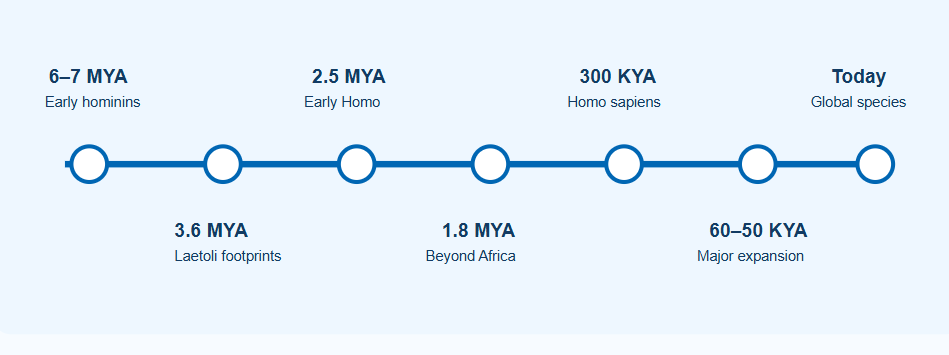
About 8–6 million years ago: the last common ancestor of humans and living chimpanzees and bonobos probably lived in Africa. The fossil record from this precise period remains sparse.About 7–6 million years ago: Sahelanthropus and other very early candidate hominins appear in Africa. Their exact positions on the family tree remain debated.About 6 million years ago: Orrorin tugenensis lived in Kenya, with femur anatomy interpreted as evidence of bipedal movement.About 4.4 million years ago: Ardipithecus ramidus lived in Ethiopia, showing a mixture of upright walking and climbing adaptations.About 3.6 million years ago: Laetoli footprints provide evidence for bipedal walking by early hominins.About 3.2 million years ago: Australopithecus afarensis, including Lucy, lived in East Africa.About 2.8–2.5 million years ago: early Homo appears around the period of early stone-tool technologies.About 1.8 million years ago: early humans were present outside Africa, including at Dmanisi in Georgia.Between roughly 1.6 million and 800,000 years ago: handaxe traditions and other advanced stone-working systems appear in different regions.By hundreds of thousands of years ago: evidence for repeated fire use, shelters, wooden technologies, hunting, and increasingly complex behavior appears in different archaeological contexts.About 300,000 years ago: the Jebel Irhoud fossils provide some of the oldest widely accepted evidence of Homo sapiens.More than 150,000 years ago: archaeological evidence indicates Homo sapiens used tropical forest environments in western Africa.Roughly 130,000–100,000 years ago: modern humans occupied parts of the eastern Mediterranean and other areas outside Africa during earlier dispersal phases.Roughly 50,000–60,000 years ago: a major expansion of Homo sapiens contributed substantially to the ancestry of later non-African populations.By tens of thousands of years ago: Homo sapiens occupied large areas of Eurasia and had reached Sahul.By the later Ice Age: Homo sapiens had reached the Americas, although exact dates and routes remain active research topics.By the end of the Pleistocene: Homo sapiens was the only surviving human species.About 12,000 years ago onward: agriculture and animal domestication emerged independently in several regions, transforming settlements, diets, disease environments, and landscapes.Today: Homo sapiens lives on every continent and has become a major force affecting ecosystems, climate, technology, and biodiversity.
21. What Human Evolution Means Today
Human evolution helps explain why our bodies have the anatomy they do. Upright walking shaped the skeleton; changing diets influenced teeth and jaws; long childhood supported learning; and changing environments shaped many aspects of physiology.Modern life differs dramatically from the environments in which most of our ancestors lived. Artificial light, processed foods, medicine, buildings, transportation, digital technology, and global trade alter the conditions in which human biology operates.Evolution has not stopped because culture became powerful. Instead, culture has become part of the human ecological system. Technology can reduce some selection pressures while creating others. Human populations remain subject to mutation, selection, drift, gene flow, and demographic change.Human diversity is also best understood through shared ancestry and population history rather than hierarchy. Different populations experienced different migration histories and local adaptations, but all living humans belong to the same species and share a deep common evolutionary history.The study of human origins therefore has a broader lesson: our species is both biologically continuous with the rest of life and culturally unusual in the scale of its learning and environmental impact.
22. Conclusion: From African Ancestors to a Global Species
Human evolution began long before Homo sapiens. The human branch emerged from an ancient African primate population and gradually accumulated changes in locomotion, anatomy, diet, technology, social learning, development, and behavior.The story contains no single magic moment. Walking upright appeared millions of years before modern humans. Stone tools appeared long before agriculture. Large brains evolved gradually. Symbolic behavior became increasingly visible later. Each development built on an older biological and cultural foundation.Homo sapiens emerged in Africa at least around 300,000 years ago, probably through interactions among multiple African populations. Later dispersals carried our species across Eurasia and into Australia and the Americas. Along the way, Homo sapiens encountered other human populations and exchanged genes with some of them.The human family tree was once much larger than it is today. Neanderthals, Denisovans, Homo erectus and other lineages remind us that our species is one surviving branch of a much richer evolutionary history.The scientific investigation is not finished. New fossils, ancient genomes, archaeological sites, dating methods, and climate reconstructions continue to refine the story. The most accurate answer to the question “How did human evolution begin on Earth?” is therefore both simple and profound: it began as a long population history in Africa, and it became human through millions of years of branching change rather than one sudden transformation.
Contents
- Introduction: The Long Story Behind a Human Question
- 1. Our Place Among the Primates
- 2. The Beginning of the Human Branch
- 3. Why Did Humans Begin Walking Upright?
- 4. Australopithecus and Lucy
- 5. The Rise of Early Homo
- 6. Fire, Food, and Technology
- 7. Homo erectus and Expansion Beyond Africa
- 8. Neanderthals and Denisovans
- 9. How Homo sapiens Emerged in Africa
- 10. Climate and Human Evolution
- 11. The Major Out-of-Africa Expansions
- 12. Australia, Asia, Europe, and the Americas
- 13. Tools, Learning, and the Evolution of Culture
- 14. Why Did Human Brains Become So Important?
- 15. From Hunter-Gatherers to Agriculture
- 16. How Fossils Reveal Our Past
- 17. What Genetics Reveals
- 18. Why Did Homo sapiens Survive?
- 19. Common Myths About Human Evolution
- 20. A Detailed Human Evolution Timeline
- 21. What Human Evolution Means Today
- 22. Conclusion: From African Ancestors to a Global Species
- Frequently Asked Questions
- Human Evolution Glossary
- Sources & Further Reading
Frequently Asked Questions
Did humans evolve from chimpanzees?
No. Humans and chimpanzees share older common ancestors. Both lineages have been evolving independently for millions of years.
When did human evolution begin?
For the human lineage, the history reaches roughly six to seven million years. Homo sapiens itself is much younger, with widely accepted fossils dating to about 300,000 years.
Where did Homo sapiens evolve?
The strongest fossil and genetic evidence places the origin of our species in Africa, increasingly understood as a process involving multiple interacting populations.
Was there one first human?
No single first human can be identified. Species emerge through population change over many generations.
Why did humans walk on two legs?
There is no single proven explanation. Efficient travel, carrying, reaching, freeing the hands, and changing environments are among the hypotheses researchers investigate.
Were Neanderthals our ancestors?
Neanderthals were close extinct relatives of Homo sapiens. They also interbred with some Homo sapiens populations, leaving genetic traces in many living people.
How do scientists know about human evolution?
They combine fossils, archaeology, genetics, ancient DNA, geology, dating methods, comparative anatomy, and environmental reconstruction.
Did humans live with dinosaurs?
No. Non-avian dinosaurs disappeared about 66 million years ago. The human lineage is only several million years old.
Is human evolution finished?
No. Mutation, selection, genetic drift, and gene flow continue, while culture changes human environments very rapidly.
Why is Africa so important?
The oldest members of the human lineage and the oldest widely accepted Homo sapiens fossils are African, and genetic diversity also strongly supports a deep African history.
Human Evolution Glossary
Adaptation
A heritable characteristic that can improve survival or reproduction in a particular environment.
Why it matters: This concept helps researchers connect evidence from fossils, archaeology, genetics, or environmental science when reconstructing the human past.
Ancient DNA
Genetic material recovered from ancient remains and used to study population relationships and history.
Why it matters: This concept helps researchers connect evidence from fossils, archaeology, genetics, or environmental science when reconstructing the human past.
Archaeology
The study of past human behavior through material remains such as tools, shelters, ornaments, and food remains.
Why it matters: This concept helps researchers connect evidence from fossils, archaeology, genetics, or environmental science when reconstructing the human past.
Australopithecus
A diverse group of extinct African hominins that lived millions of years ago.
Why it matters: This concept helps researchers connect evidence from fossils, archaeology, genetics, or environmental science when reconstructing the human past.
Bipedalism
Walking or moving habitually on two legs.
Why it matters: This concept helps researchers connect evidence from fossils, archaeology, genetics, or environmental science when reconstructing the human past.
Cultural evolution
Change in learned behaviors, technologies, symbols, and social practices across generations.
Why it matters: This concept helps researchers connect evidence from fossils, archaeology, genetics, or environmental science when reconstructing the human past.
Denisovan
An extinct human population identified especially through ancient DNA and a limited fossil record.
Why it matters: This concept helps researchers connect evidence from fossils, archaeology, genetics, or environmental science when reconstructing the human past.
Evolution
Change in inherited characteristics of populations across generations.
Why it matters: This concept helps researchers connect evidence from fossils, archaeology, genetics, or environmental science when reconstructing the human past.
Fossil
Preserved remains or traces of ancient organisms.
Why it matters: This concept helps researchers connect evidence from fossils, archaeology, genetics, or environmental science when reconstructing the human past.
Gene flow
Movement of genetic variants between populations through migration and reproduction.
Why it matters: This concept helps researchers connect evidence from fossils, archaeology, genetics, or environmental science when reconstructing the human past.
Genetic drift
Random changes in genetic variant frequencies, especially influential in small populations.
Why it matters: This concept helps researchers connect evidence from fossils, archaeology, genetics, or environmental science when reconstructing the human past.
Hominin
Humans and extinct relatives on the human side of the evolutionary split from chimpanzees and bonobos.
Why it matters: This concept helps researchers connect evidence from fossils, archaeology, genetics, or environmental science when reconstructing the human past.
Homo erectus
A long-lived group of early humans associated with major body, technological, and geographic changes.
Why it matters: This concept helps researchers connect evidence from fossils, archaeology, genetics, or environmental science when reconstructing the human past.
Homo sapiens
The scientific species name for modern humans.
Why it matters: This concept helps researchers connect evidence from fossils, archaeology, genetics, or environmental science when reconstructing the human past.
Jebel Irhoud
A Moroccan site with approximately 300,000-year-old fossils among the oldest widely accepted Homo sapiens remains.
Why it matters: This concept helps researchers connect evidence from fossils, archaeology, genetics, or environmental science when reconstructing the human past.
Laetoli
A Tanzanian site famous for about 3.6-million-year-old hominin footprints.
Why it matters: This concept helps researchers connect evidence from fossils, archaeology, genetics, or environmental science when reconstructing the human past.
Natural selection
A process in which heritable differences affect reproductive success in particular environments.
Why it matters: This concept helps researchers connect evidence from fossils, archaeology, genetics, or environmental science when reconstructing the human past.
Neanderthal
Homo neanderthalensis, a close extinct human relative known from Europe and western Asia.
Why it matters: This concept helps researchers connect evidence from fossils, archaeology, genetics, or environmental science when reconstructing the human past.
Oldowan
A broad term for early stone-tool technologies involving cores and flakes.
Why it matters: This concept helps researchers connect evidence from fossils, archaeology, genetics, or environmental science when reconstructing the human past.
Out of Africa
A term describing dispersals of humans from Africa into Eurasia; it can refer to multiple waves.
Why it matters: This concept helps researchers connect evidence from fossils, archaeology, genetics, or environmental science when reconstructing the human past.
Pan-African model
A model in which Homo sapiens emerged through interaction among multiple African populations.
Why it matters: This concept helps researchers connect evidence from fossils, archaeology, genetics, or environmental science when reconstructing the human past.
Pleistocene
A geological epoch containing most of human evolutionary history, ending about 11,700 years ago.
Why it matters: This concept helps researchers connect evidence from fossils, archaeology, genetics, or environmental science when reconstructing the human past.
Primate
The mammalian order containing lemurs, monkeys, apes, and humans.
Why it matters: This concept helps researchers connect evidence from fossils, archaeology, genetics, or environmental science when reconstructing the human past.
Selection pressure
An environmental or biological factor that changes the relative reproductive success of individuals with different heritable traits.
Why it matters: This concept helps researchers connect evidence from fossils, archaeology, genetics, or environmental science when reconstructing the human past.
Variation
Differences among individuals in a population; heritable variation is essential to evolution.
Why it matters: This concept helps researchers connect evidence from fossils, archaeology, genetics, or environmental science when reconstructing the human past.
Sources & Further Reading
This article is an educational synthesis. Dates and interpretations can change as new fossils, archaeological discoveries, genetic evidence, and dating methods become available.
- Smithsonian Human Origins Program — Introduction to Human Evolution
- Smithsonian Human Origins Program — Homo sapiens
- Smithsonian Human Origins Program — Dating
- Natural History Museum — Modern Humans: When, Where and How Did We Evolve?
- Natural History Museum — How Homo sapiens Spread Out of Africa
- Smithsonian — Key Facts About Human Origins
- Smithsonian — Milestones in Human Evolution