
Acknowledgments
The authors wish to thank Professor J.D. Legge for his full and
courteous assistance as general editor of the Cassell Asian Histories; Professor E.S. Crawcour for his encouragement; Miss Wyn
Mumford for preparing the maps and line drawings; Mrs. Ruth Rush
for her typing; Miss Mary Hutchinson for proof reading; individuals and institutions in Japan and Australia, particularly the International Society for Educational Information in Tokyo, for
supplying photographs for the illustrations; and, for the illustration on page 111, A.L. Sadler and Charles E. Tuttle Co. Inc.; and,
finally, the authors and publishers listed in the bibliography for
permission to reprint copyright material.
It is appropriate to include here a word of appreciation for the
courteous and invaluable help received from the late Mr. Jim Ellis
of Cassell, Australia, when the first edition of this book was being
written and prepared for publication.
CREDITS
Ministry of Foreign Affairs: facing pp. 72,73 (upper), 90 (lower left, right),
91, 162 (lower left, right), 250 (lower), 318, 319. International Society for
Educational Information: facing pp. 73 (lower left), 162, 250 (upper), 272
(upper), between pp. 318-19 (Togo Seiji). National Museum, Tokyo: facing
pp. 163, 178 (upper), 179 (upper left), between pp. 318-319 (Shimomura
Kanzan). Kokusai Bunka Shinkokai: facing p. 178 (lower left, right),
between pp. 318-19 (Tomioka Tessai). Nezu Art Museum: facing p. 179
(upper right). National Gallery of Victoria: facing p. 179 (lower). Shiryo
Hensanjo, Tokyo University: facing p. 251 (upper). Meiji Bunko, Tokyo
University: facing p. 272 (lower). Kyodo News Agency: facing p. 273
(upper). United States Navy: facing p. 273 (lower)
Environment and Early Settlement
The early Japanese, like all oth~r peoples, wove mythological stories to explain the origin of their land. At a time in the dim, distant
past, so one of these myths relates, two gods stood on the Aoating
Bridge of Heaven. Wondering whether there was lanfl below, they
took a jeweled spear and dipped it down into the ocean. The brine
that dripped from the point of the spear formed an island. Descending to this island, the gods, one male and one female, erected a
pillar and, when they had danced round it and conversed in the
proper order (the male speaking first), they produced offspring:
the eight main islands of Japan.
These days the Japanese tum not to the creation myths of the
gods Izanagi and Izanami but to the work of archaeologists and
their scientist colleagues for a rational account of their land,
its formation and early settlement. Yet the old stories draw attention to the fact that the country consists of a chain of islands; and
this is something which has influenced its inhabitants throughout
history.
Japan took its present shape as a string of islands about 20,000
years ago. Great natural forces cut off the four largest islands of
Japan and hundreds of smaller ones from the continent of Asia,
leaving an arc of islands strung out over 2,400 kilometers. These
were once linked in the south to the Korean peninsula and to China, and in the north to Siberia, leaving the Japan Sea as a huge lake.
With a rise in sea level, the land bridge in the south disappeared; .
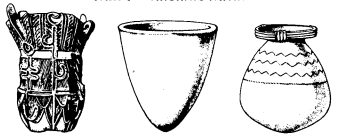
The piece in the center, crudely shaped, thick and brittle, is a reconstruction of one of
Japan’s earliest pots, presumably put to a variety of uses; on the left is a Middle Jomon
pot with characteristically elaborate ornamentation; on the right is a storage jar showing
the simplicity typical ofYayoi pots.
later the northern land bridge also disappeared. It was in this changing world that man began his habitation.
At one time Japanese archaeologists thought that human occupation of the islands dated back to 5000 B.c. at the earliest, and that
the first inhabitants used pottery. Now they are sure that people
who did not use pottery lived in Japan long before that time, and
though it is uncertain exactly how long, most Japanese archaeologists would say from about ,30,000 years ago. Nor is it known how
they crossed from Asia to the Japanese islands, but probably by the
land bridges. These early inhabitants of Japan are known mainly
by their stone implements such as pointed knives, blade flakes,
scrapers, knife blades, hand axes, and so on, though some remains
of dwellings and human skeletons have been found.
Pottery, that durable indication of a developing people, was made
in Japan before I 0,000 B.c. This date is the earliest in the world;
but when advanced techniques are more widely used in investigating early settlement of neighboring areas in Korea, China, and
Siberia, the early development of pottery in Japan may be seen in
a different perspective. Nevertheless, the artistic qualities of the
pottery, which changed as new uses were evolved and new decorative effects attempted, are of a high order, and it also has an
important trait of regional variation. It is named Jomon (ropemarked), and gives its name to the culture associated with it.
What we know of the way of living of Jomon people comes
from the materials found in their pit dwellings and refuse heaps.
They were gatherers, hunters, and fishers; but they also practiced
rudimentary cultivation after about 5000 B.c. When their control
over their environment permitted, they settled for a time in camps
by rivers and springs in the mountains or by the sea. The shell
mounds left by the Jomon people furnish the f-ullest evidence of
their lives, and show us that they hunted deer, boar, and many other
animals with bows and arrows, and fished with harpoons and bone
fish-hooks. Quite a number of skeletons ofJomon people have been
preserved in the mounds where the shells’ lime has acted as a neutralizer. (Because of the humid climate and acidity of the soil in
Japan, skeletons outside shell mounds disintegrated quickly.) It is
difficult to tell from the Jomon skeletons whether these people were
the ancestors of the present-day Japanese or not; nor do we know
whether the Jomon people were the ancestors of the people
who produced the next and one of the greatest changes in Japanese
history.
· This change was the introduction of sophisticated forms of
agriculture into a hospitable environment. In winter, the country’s
proximity to the Asian continent gives it a climate not greatly different from that of the eastern edge of Siberia, though the Siberian
winds are neither as dry nor as cold after crossing the Japan Sea.
In summer, with warm moist winds blowing towards the continent,
Japan shows herself more clearly to be a chain of islands in the
Pacific. These monsoon winds from the ocean give ample rain ·in
summer, permitting rice to grow. Wet rice farming became established in western Japan sometime after 500 B.c., probably as a result
. of emigrants from the continent being driven out by disturbed
conditions. Land in valley bottoms and coastal plains was drained,
leveled, and irrigated in operations demanding communal effort.
Similarly the planting, transplanting, and harvesting of rice demanded coordinated effort by a community. The new people and knowledge spread very quickly from west to east, and enabled a far denser
population to live in one place. Permanent villages began to appear. In this way, in Japan as elsewhere, agriculture led people to
make more efficient use of their environment. Apart from indirect
evidence of rice growing, such as stone sickles and wooden hoes,
charred grains of rice and chaff have been found in jars and imprinted on pots. These finds enable us to say that the grain
originat-ed in eastern Chin~, though it probably came through north China and Korea.
Again the pottery has given its name to the culture of its creators. The name Yayoi, after the district in Tokyo where this plain,regular type of pot was first found in 1884, is used to describe the period in Japanese history when rice growing, metal working, and cloth making, as well as the new pottery, were introduced from
continental Asia. Tools, weapons, and mirrors of bronze and iron were in time made in Japan. Bronze articles (swords, mirrors and a bell-like object known as dotaku) seem to have been used as symbols of power and for religious rituals, while iron was used by farmers and· builders. An iron working-edge greatly improved the efficiency of implements used in daily work for such tasks as shaping wooden spades, rakes, and hoes, and splitting the wooden slats used to reinforce paths between the rice fields. The wooden farming tools
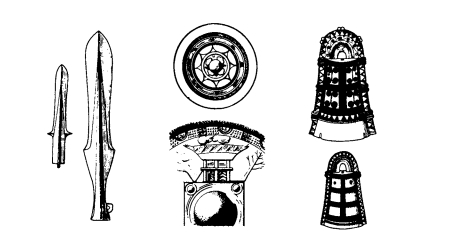
This flat bronze sword and spearhead (left) of local make were originally patterned on
continental examples. In Japan there was a tendency for these to become ritual artifacts
(badges of office) rather than weapons of war. The complete mirror shown here (center)
is of Chinese origin, but the lower drawing shows the central part of a later mirror, made
in Japan, decorated with a raised storehouse of the Yayoi period. The bronze bells (right),
of peculiarly Japanese design, exemplify the level of sophistication reached by the Japanese in the Yayoi period.
used in Yayoi times and pre~erved in the mud bear a striking resemblance to the tools used less than a century ago. It is only in the
twentieth century that the load borne by human labor has been lightened by the use of machines, with profound social effects.
Despite all these developments the Japanese were still far from
being as civilized as the Chinese. In the sense that they had no written
script, they were still a prehistoric people before about A.D. 400. 1
However, Chinese writings, almost certainly based on travelers’
reports, provide a picture of life. The passage that follows is taken
from a third-century A.D. Chinese history that included a section
on·the land ofWa (Japan).
The social customs [of the Wa] are not lewd. The men wear a
band of cloth around their heads, exposing the top. Their clothing
is fastened around the body with little sewing. The women wear
their hair in loops. Their clothing is like an unlined coverlet and is
worn by slipping the head through an opening in the center. [The
people] cultivate grains, rice, hemp, and mulberry trees for senculture. They spin and weave and produce fine linen and silk fabrics. There are no oxen, horses, tigers, leopards, sheep, or magpies.
Their weapons are spears, shields, and wooden bows made with
short lower part and long upper part; and their bamboo arrows are
sometimes tipped with iron or bone ….
The land of Wa is warm and mild [in climate]. In winter as in
summer the people live on vegetables and go about bare-footed.
Their houses have rooms; father and mothers, older and younger,
sleep separately. They smear their bodies with pink and scarlet,
just as the Chinese use powder. They serve meat on bamboo and
wooden trays, helping themselves with their fingers. When a person dies, they prepare a single coffin, without an outer one. They
cover the graves with sand to make a mound. When death occurs,
mourning is observed for more than ten days, during which period
they do not eat meat. The head mourners wail and lament, while
friends sing, dance, and drink liquor. When the funeral is over, all
members of the whole family go into the water to cleanse themselves in a bath of purification.
When they go on voyages across the sea to visit China, they
always select a man who does not arrange his hair, does not rid
himself of fleas, lets his clothing [get as] dirty as it will, does not
eat meat, and does not approach women. This man behaves like a
mourner and is known as the fortune keeper. When the voyage turns
out propitious, they all lavish on him slaves and other valuables. In
case there is disease or mishap, they kill him, saying that he was
not scrupulous in his duties.2
Such an account shows that Japan was clearly a part of the ricegrowing, metal-working civilization of East Asia, but not yet a
highly developed part, the Japanese being still a long way from
achieving that degree of unity which already at times made China
a powerful and centralized empire. Yet in time, and in its own way,
Japan was to achieve a degree of unification that is remarkable both
in political and cultural terms. The earliest phases of this development, in the nuclear areas of northern Kyushu, western and central
Honshu, and northern Shikoku,3 were not recorded in writing until
centuries had passed, but the archaeologist is recovering more and
more detail about the beginnings of Japan as a civilized state. Yayoi period settlements have been unearthed which show that a few
of the people had been treated in a privileged Jvay both when alive
and dead. This finding has caused some excitement because such
distinction is seen as a step in the important process of social selection that creates a few families who wield conspicuously greater
power in agricultural communities. For example, continuing excavations at Yoshinogari are giving us a remarkably complete picture
of a large Yayoi complex with clear evidence of defensive features
and social stratification. Though never previously_ uncovered on
such a scale, sites similar to Yoshinogari were probably common
through many of the western regions of the archipelago during the
Yayoi period.4
‘ Their spoken language probably resembled the continental Asian language group Altaic, of
which the westernmost member is Turkish, with words that suggest links with southeast Asia.
‘Tsunoda and Goodrich, Japan in the Chinese Dynastic Histories-Later Han Through Ming
Dynasties, pp. 10–11. .
3 Along with the slow processes of unification in the areas mentioned, it must be remembered
that they are far from corresponding to modern Japan; also, all over the islands regional variation, local autonomy, and local interests have been major themes of Japanese history.
•see Hudson and Barnes, “Yoshinllgari: A Yayoi Settlement in Northern Kyushu,” Monumenta
Nipponica, Vol. 46, no. 2 (1991), pp. 211–35.