INDIA–JAPAN INVESTMENT
Future Manufacturing, AI & Infrastructure
Executive Summary
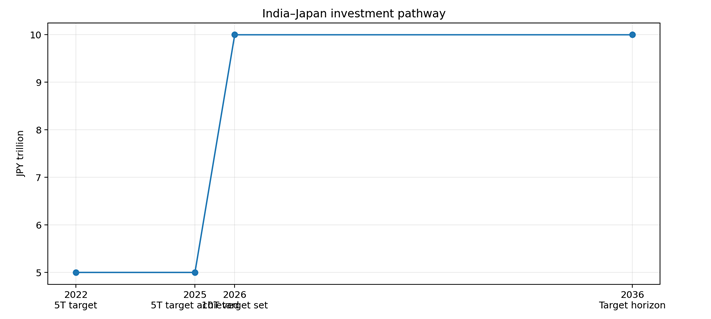
India and Japan are entering a more ambitious phase of economic cooperation in which investment is increasingly connected with technology, manufacturing capability, economic security, infrastructure and long-term resilience. The relationship has moved beyond a conventional capital-and-trade partnership. Japan brings deep strengths in precision manufacturing, industrial engineering, robotics, mobility, materials, infrastructure finance, quality systems and selected advanced technologies, while India contributes a large and growing market, engineering and digital talent, a broad startup ecosystem, expanding infrastructure demand and an increasingly important position in global supply chains. The central opportunity is to combine these strengths rather than treat investment as a one-way flow of capital.The strategic scale of the relationship has increased sharply. At the 2025 India–Japan summit, the two governments noted that the earlier JPY 5 trillion public and private investment and financing target, set in 2022, had been achieved in three years and agreed on a new JPY 10 trillion private-investment target for India. Official Indian and Japanese statements also placed semiconductors, AI, clean energy, critical minerals, mobility, digital infrastructure and supply-chain resilience near the center of the next phase. These priorities are important because the next wave of investment is likely to be judged not only by the amount of money deployed, but by the productive capability, technology, employment, export capacity and resilience created by that investment.By 2026, the technology agenda had become even more concrete. Japan and India had already established the Digital Partnership 2.0, covering semiconductors, AI, digital public infrastructure, digital talent, research and development and startup cooperation. In April 2026 the two sides held their first Japan–India AI Strategic Dialogue, while the July 2026 India–Japan AI joint statement called for cooperation on AI infrastructure including data centers, GPU and other compute resources, and semiconductors. A separate 2026 battery cooperation memorandum also emphasized reliable supply chains, investment, technology cooperation, intellectual-property protection and regional stakeholder engagement. These developments suggest that the investment story is evolving into a technology-and-production ecosystem story.For India, Japanese investment can help deepen manufacturing, raise quality standards, develop supplier networks and connect domestic production to global value chains. For Japan, India can provide a large growth market and a diversified production base at a time when companies are seeking resilient supply chains and new sources of demand. The strongest opportunities are therefore likely to be joint ventures, local manufacturing, supplier development, research partnerships, technology localization, infrastructure projects, industrial parks, AI and semiconductor ecosystems, and investment in companies that can sell into both markets and the wider Indo-Pacific.This report examines that opportunity with a forward-looking lens. It covers the investment relationship, manufacturing, semiconductors, AI, data centers, digital public infrastructure, transportation and logistics, batteries and electric mobility, clean energy, healthcare, agriculture, skills, startups and MSMEs, economic security, regional development, financing structures, policy risks and a practical roadmap for investors. The analysis distinguishes official facts from forward-looking judgments. The objective is not to claim that every sector will automatically attract capital, but to identify where India and Japan have the strongest strategic complementarity and what conditions are necessary to convert political intent into commercially durable projects.
1. The India–Japan Investment Relationship: From Partnership to Production Ecosystem
2. Why Manufacturing Is the Core Opportunity
Manufacturing is likely to remain the central channel through which India–Japan investment creates durable economic capacity. Japan has one of the world’s strongest industrial traditions, with globally competitive companies and deep expertise in automobiles, machinery, electronics, materials, robotics and production systems. JETRO describes manufacturing as roughly one-fifth of Japan’s GDP and highlights digitalization and decarbonization as major drivers. India, meanwhile, is seeking to increase manufacturing depth, integrate into global value chains and create productive employment at scale. The complementarity is unusually strong because one side has mature industrial know-how and the other has a large market, talent pool and expansion runway.
The first layer of opportunity is automobiles and mobility. Japanese automakers have already created extensive manufacturing footprints in India, but the next phase is likely to move beyond conventional internal-combustion vehicles toward hybrids, electric vehicles, batteries, power electronics, sensors, software-defined vehicles and intelligent mobility. India can become a manufacturing and engineering base for products designed for emerging-market conditions, while Japanese firms can contribute reliability, process discipline, component technology and global quality systems. The commercial opportunity will be strongest where Indian suppliers are upgraded rather than bypassed.
The second layer is industrial automation. Japan faces labor constraints and has strong capabilities in industrial robots, machine tools and factory automation. India needs productivity gains as wages rise and manufacturers compete globally. Joint deployment of robotics, machine vision, predictive maintenance and AI-based quality control can allow Indian factories to increase output without relying exclusively on larger workforces. This is particularly important for electronics, automotive components, pharmaceuticals, food processing and precision engineering. It also creates a new business model in which Japanese technology suppliers work with Indian system integrators and software firms.
The third layer is electronics and semiconductors. Semiconductor cooperation is strategically important because chips sit underneath AI, vehicles, telecommunications, industrial equipment and defense-related systems. India has strengths in chip design, software and engineering talent, while Japan has important capabilities across semiconductor materials, equipment, manufacturing know-how and industrial supply chains. The opportunity is not limited to leading-edge wafer fabrication. Packaging, testing, power semiconductors, sensors, materials, equipment maintenance, specialty chemicals, design services and industrial electronics can all form commercially meaningful ecosystems.
The fourth layer is precision engineering. Japanese firms often compete through reliability, process control and incremental improvement rather than only through headline innovation. India can benefit from that discipline in machine tools, industrial components, medical devices, aerospace components, specialty chemicals and capital goods. A Japanese–Indian production partnership can use Japanese process engineering and Indian cost engineering to create products that compete in emerging markets without sacrificing quality. The most promising projects are likely to be those where the Indian operation has a clear mandate for product development, supplier development and exports rather than being only a low-cost assembly site.
The fifth layer is industrial infrastructure. Manufacturing requires land, power, water, logistics, testing, warehousing, waste treatment and skilled labor. Japan Industrial Townships and related industrial cooperation provide a framework for clustering Japanese companies and suppliers. Such clusters can reduce transaction costs, improve access to common infrastructure and create a visible destination for additional investors. The next generation of industrial parks should add digital infrastructure, renewable power, worker housing, training centers, research labs and shared testing facilities so that an investment ecosystem can grow around the initial factory.
Manufacturing also creates a bridge between the physical and digital economies. Smart factories use sensors, industrial networks, cloud platforms, AI and digital twins to optimize production. Indian software companies can contribute application development, analytics and system integration, while Japanese companies contribute factory equipment, automation and operational know-how. If these capabilities are integrated, India can become a testbed for affordable, scalable industrial digitalization that can later be exported to Southeast Asia, Africa and other emerging markets.
3.Semiconductors, Electronics and Strategic Supply Chains
Semiconductors are becoming one of the most strategically important India–Japan investment themes. The 2025 Digital Partnership 2.0 explicitly identified semiconductor cooperation, including R&D collaboration, investment and supply-chain resilience. In 2026, economic-security cooperation continued to emphasize semiconductors, critical minerals, AI and other strategic technologies. This is significant because semiconductor ecosystems are built over many years and require coordination among governments, manufacturers, equipment suppliers, materials companies, universities, logistics providers and customers.
India’s opportunity is not to reproduce every layer of the global semiconductor industry at once. A more realistic approach is to build competitive niches and connect them to Japanese strengths. These niches can include chip design, embedded systems, power electronics, sensors, semiconductor packaging and testing, compound semiconductors, equipment servicing, materials and electronics manufacturing. Japanese companies can help provide equipment, materials, process expertise, quality systems and customer relationships. Indian firms can contribute design talent, software integration, engineering services and scale.
The strongest business cases will be built around demand. Automotive electronics, industrial automation, telecommunications, consumer electronics, renewable-energy equipment and data centers all require semiconductor content. India can use its expanding domestic market to create anchor demand for locally produced components while simultaneously designing plants for exports. Japan can help connect Indian facilities to global procurement networks. This is especially valuable for components that do not require the very latest process nodes but do require high reliability, long product lifecycles and strong quality assurance.
Packaging and testing deserve special attention because they can become a bridge between semiconductor design and full-scale fabrication. Advanced packaging is increasingly important for performance, power efficiency and AI systems. India can combine its engineering workforce with Japanese process technology and equipment to build packaging capabilities serving automotive, industrial and computing customers. Over time, such facilities can support a wider materials and equipment ecosystem.
Critical minerals and materials are another part of the semiconductor story. Advanced manufacturing depends on specialty chemicals, high-purity materials, rare or strategically important minerals and sophisticated processing. India and Japan can cooperate on resource mapping, recycling, refining, materials science and supply-chain monitoring. Suchcooperation reduces vulnerability to sudden disruptions while also creating new investment opportunities in processing and circular-economy technologies.The policy challenge is to avoid an investment model based solely on subsidies. Public support can help overcome high initial capital costs and coordinate infrastructure, but long-term competitiveness depends on yield, reliability, customer qualification, logistics, power quality, talent and continuous process improvement. Japanese participation can help strengthen these operational capabilities. Indian participation can provide local scale and adaptability. The result should be an ecosystem that remains commercially viable as incentives evolve.
4. Artificial Intelligence and the New Digital Infrastructure Economy
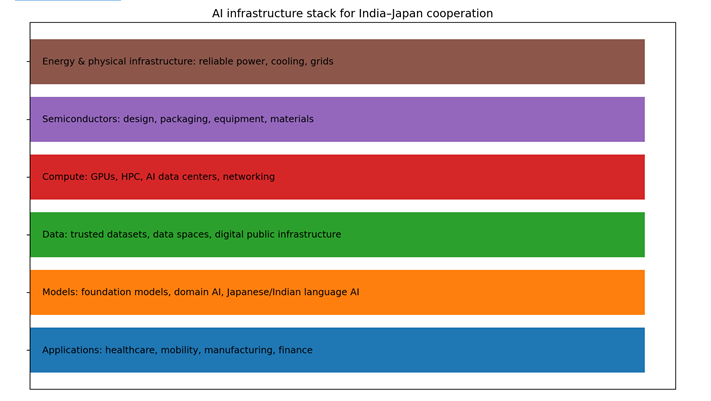
AI is moving from an application story to an infrastructure story. The 2026 India–Japan AI joint statement called for cooperation on secure digital infrastructure for AI, including data centers, GPU and other compute resources and semiconductors. This matters because AI requires a physical stack: electricity, land, cooling, fiber networks, servers, accelerators, storage, security, data governance and skilled operators. Investment in AI therefore creates opportunities across construction, energy, telecom, electronics, cloud computing and advanced manufacturing, not only in software.India has significant advantages in software engineering, digital services, startup formation and large-scale digital public infrastructure. Its IndiaAI Mission was approved with a budget outlay of Rs.10,371.92 crore and a goal of establishing public AI compute infrastructure of 10,000 or more GPUs, alongside programs for foundation models, startups, data quality, talent and responsible AI. Japan brings complementary strengths in industrial AI, robotics, high-quality hardware, advanced research, corporate R&D and trustworthy technology governance. The partnership can therefore move beyond generic AI applications toward joint development of industrial and societal AI systems.A major opportunity is AI for manufacturing. Japanese factories generate rich operational data from machines, sensors and production lines, while Indian software companies can build analytics and AI layers around that data. Joint projects can address predictive maintenance, visual inspection, production scheduling, energy optimization, inventory planning and worker assistance. These systems can improve productivity without requiring every factory to become a frontier-model developer. Domain-specific AI is often more commercially practical because it is tied to measurable operating outcomes.
Another opportunity is multilingual and domain-specific AI. India has a large number of languages and enormous variation in consumer and institutional contexts. Japan has strong demand for systems that work with Japanese language, industrial documentation and aging-related services. Joint research can produce models and tools for translation, industrial knowledge retrieval, healthcare administration, education, public services and enterprise workflows. The combination can create products that are designed for Asian markets rather than optimized only for English-speaking environments. AI data centers create a direct bridge between investment and infrastructure. Japan’s 2025 investment reporting noted strong greenfield activity in data centers and logistics, reflecting AI and automation demand. India can offer growing digital demand and expanding renewable-energy capacity, while Japan can contribute equipment, cooling, power-management, network, robotics and data-center engineering capabilities. Investment models should prioritize reliable electricity, efficient cooling, water stewardship, cybersecurity and resilient connectivity. In regions where renewable power is abundant, data-center investment can also support new generation and grid infrastructure.
Trustworthy AI is a shared strategic interest. The 2025 Digital Partnership 2.0 included cooperation on trustworthy AI and international AI governance, while the 2026 joint statement emphasized safe, secure and trustworthy AI ecosystems. For investors, this means governance should be designed into products rather than added after deployment. Joint standards for testing, auditability, cybersecurity, data protection, model evaluation and human oversight can reduce cross-border friction and create a stronger basis for commercial scale.
The largest long-term opportunity may be the convergence of AI and physical systems. Japan’s strength in robotics and industrial equipment can be combined with India’s software and AI talent to develop autonomous or semi-autonomous factories, logistics systems, agricultural equipment, healthcare devices and smart-city services. This convergence can produce intellectual property that is jointly owned, jointly commercialized or licensed across markets. It also creates an incentive to build research partnerships between universities, Japanese corporate labs, Indian technology companies and startups.
5. Infrastructure, Mobility, Logistics and Smart Cities
Infrastructure is one of the most visible pillars of India–Japan economic cooperation. Japan has supported quality infrastructure in India through financing, technology and project expertise, while India’s urbanization and logistics transformation create sustained demand. The next phase should focus not only on individual projects but on connected infrastructure systems: rail linked to logistics parks, ports linked to freight corridors, industrial clusters linked to renewable energy and cities linked to digital public services.
High-speed rail is the flagship example of technology-intensive infrastructure cooperation. Its importance goes beyond the rail line itself because complex infrastructure projects develop domestic capabilities in project management, construction, signaling, maintenance, safety and supply chains. Over time, the objective should be to localize an increasing share of equipment and expertise while maintaining Japanese safety and quality standards. This can create an Indian supplier ecosystem capable of serving future domestic projects and exporting selected components.Freight and logistics offer an even broader commercial opportunity. India’s manufacturing ambitions depend on predictable movement of components and finished goods. Japanese companies can contribute warehouse automation, port technology, cold-chain systems, route optimization, rail logistics, packaging and quality control. Indian companies can contribute software, local operations and market knowledge. Digital logistics platforms can connect these capabilities and reduce inventory costs. The strongest projects will integrate physical infrastructure with data rather than treat them as separate investments.Smart-city investment is also evolving. The future smart city is not primarily a collection of sensors; it is an operating system for mobility, energy, water, waste, public safety and citizen services. India can use digital public infrastructure and large-scale digital platforms, while Japanese firms can contribute energy-efficient equipment, mobility systems, building technologies and urban planning. Joint projects can focus on measurable outcomes such as reduced congestion, lower energy use, improved waste collection and more reliable public transport.Infrastructure financing should increasingly use blended models. Public investment can provide the foundation, while private capital finances revenue-generating assets or operating businesses. Japanese banks, infrastructure funds, trading houses, manufacturers and institutional investors can partner with Indian developers and state-level agencies. Transparent procurement, predictable contracts, land availability and reliable utility connections are essential to making these models bankable. The more projects move from one-off government procurement to repeatable commercial platforms, the faster investment can scale.The next opportunity is infrastructure for digital and industrial growth. Data centers, industrial parks, testing labs, semiconductor facilities and advanced manufacturing campuses require specialized power, cooling, water, fiber and logistics. Such infrastructure can be planned as integrated zones. Japan’s experience with industrial clustering and high-reliability infrastructure can complement India’s large-scale development needs. The result can be a new generation of industrial cities designed around technology, exports and resilience.
6. Batteries, Electric Mobility and Clean Energy
The transition to cleaner transport creates another major India–Japan investment corridor. Japan has extensive experience in batteries, hybrid vehicles, power electronics, energy management and industrial quality control, while India has a rapidly growing mobility market and a policy objective of building domestic manufacturing capacity. In July 2026, Japan’s METI and India’s Ministry of Heavy Industries signed a battery cooperation memorandum emphasizing reliable supply chains, public support, investment, technology cooperation, intellectual-property protection and coordination with local stakeholders. This creates a concrete policy platform for deeper private-sector participation.Battery cooperation should extend beyond cell manufacturing. A competitive battery ecosystem includes minerals, refining, active materials, cell chemistry, cell manufacturing, modules, battery-management systems, thermal management, charging equipment, recycling and second-life applications. India and Japan can cooperate at several points in this chain. Japanese companies can bring technology and quality systems; Indian firms can provide manufacturing scale, engineering talent and access to a growing domestic market. Joint ventures can also develop products tailored to Indian heat, road and usage conditions.
Hybrid vehicles may remain important because they can reduce fuel consumption while avoiding some of the charging-infrastructure constraints of fully electric fleets. At the same time, India and Japan can pursue electric buses, two-wheelers, three-wheelers, commercial vehicles and industrial equipment where electrification economics can be attractive. The strongest strategy is therefore technology-neutral at the system level: invest in the mobility technologies that deliver measurable efficiency, lower emissions and competitive lifecycle costs.
Clean energy is an enabling condition for advanced manufacturing and AI infrastructure. Semiconductor plants, data centers and industrial parks require high-quality electricity around the clock. India and Japan can cooperate on renewable generation, storage, green hydrogen, ammonia, grid management and energy efficiency. The 2025 bilateral outcomes included cooperation on hydrogen and ammonia, while the 2026 agenda continued to emphasize energy security and sustainable fuels. Investment in clean energy should therefore be seen not only as climate policy but also as industrial policy.
Circularity is another investment opportunity. Batteries, electronics and industrial equipment create large future waste streams. Japanese expertise in recycling, materials recovery and resource efficiency can combine with India’s large domestic volumes to build commercially viable recycling networks. These systems can reduce import dependence on critical materials, create jobs and improve environmental performance. Standards for battery passports, traceability and recycling could further support cross-border supply chains.
The investment case for clean energy becomes strongest when it is integrated with manufacturing. A Japanese manufacturer locating in India can contract for renewable power, install energy-management systems, develop local suppliers and use low-carbon production as a competitive advantage in export markets. Similarly, an Indian industrial park can attract Japanese tenants by offering reliable low-carbon electricity and efficient logistics. The resulting ecosystem links capital, technology, energy security and exports.
7. Healthcare, Pharmaceuticals, Agriculture and Human-Centered Growth
Investment cooperation should not be limited to heavy industry and digital infrastructure. Healthcare, pharmaceuticals, medical devices, elder care and biotechnology are promising because both countries face demographic and productivity challenges. Japan has advanced healthcare technologies, medical equipment, pharmaceuticals, robotics and experience with an aging society. India has a large pharmaceutical industry, a strong base of doctors and engineers, cost-efficient manufacturing and a huge domestic market. Joint investment can combine these strengths in ways that generate both commercial and social value.
Medical devices are particularly suitable for manufacturing partnerships. India needs affordable diagnostic equipment, hospital devices, monitoring systems and digital health technologies, while Japanese companies can contribute precision engineering and reliability. Joint product development can focus on affordability without compromising safety. Manufacturing in India can serve domestic demand and selected export markets. The key is to develop local supplier capabilities for components, plastics, electronics, sensors and software rather than importing complete systems indefinitely.Elder care is a natural area for cooperation because Japan has long experience with demographic aging. India can develop technology-enabled care models that combine Japanese robotics and service design with Indian healthcare professionals and software platforms. AI-assisted documentation, remote monitoring, mobility support and home-care coordination could create new service businesses. These solutions can also become exportable to other Asian markets that will experience similar demographic changes.Agriculture and food processing offer a different but equally important opportunity. India’s large agricultural base creates demand for cold chains, irrigation technology, precision farming, food processing, packaging and logistics. Japanese companies can contribute quality systems, sensors, automation and post-harvest technology. Indian firms can contribute local distribution and large-scale operations. Investment can be structured around clusters that connect farmers to processors, exporters and retailers, reducing waste and improving value addition.Biotechnology and life sciences can develop through joint research and manufacturing. India has pharmaceutical and biotech capabilities, while Japan has strong research institutions and advanced medical technology. Joint labs, translational research centers and startup funds can help move discoveries from research into commercial products. Regulatory cooperation and shared quality standards will be important because life-science projects require longer timelines and higher confidence than ordinary consumer businesses.
Human-centered investment is strategically important because economic partnerships are more durable when communities see benefits. Manufacturing and infrastructure projects can create jobs, but training, housing, healthcare, safety and local supplier development determine whether those benefits persist. Japanese companies often bring structured training and workplace practices, while Indian institutions can provide scale and local networks. Combining these approaches can produce a workforce ecosystem that supports productivity and social stability.
8. Skills, Talent Mobility, Startups and MSMEs
Talent is the connective tissue of the India–Japan investment relationship. Capital can finance a factory, but skilled engineers, technicians, managers, researchers and software developers determine whether that factory reaches international productivity levels. The two countries have already built skill-development mechanisms, including Japan–India Institutes of Manufacturing, Japanese Endowed Courses and worker mobility programs. The next phase should scale these initiatives around the needs of advanced manufacturing, semiconductors, AI, robotics, batteries and infrastructure.Japan’s demographic pressures create an additional reason to deepen talent cooperation. Manufacturing, healthcare and logistics require workers even as Japan’s working-age population faces constraints. India has a large young workforce and expanding technical education capacity. Properly designed mobility programs can therefore be mutually beneficial. The goal should not be a simple export of labor; it should be a skills partnership in which workers gain advanced capabilities, companies gain productivity and returning workers transfer knowledge into Indian industry.Training should be linked directly to employers. A practical model is a three-part partnership among a Japanese company, an Indian technical institution and a state or industry body. The company defines the skill standard, the institution provides training and the public partner supports equipment, apprenticeships and certification. This model can be applied to robotics technicians, semiconductor equipment operators, battery engineers, data-center technicians, industrial AI specialists and railway maintenance professionals.Startups can add a different form of flexibility. Large Japanese corporations have capital, technology and customer relationships, while Indian startups often move quickly and specialize in software, AI, fintech, industrial technology or new business models. Bilateral startup funds, corporate venture programs, accelerators and cross-border pilot programs can connect these strengths. The 2025 Digital Partnership 2.0 explicitly included startup collaboration, investment-fund development, centers of excellence and business matching.
MSMEs should be treated as strategic infrastructure rather than as a peripheral category. Japanese manufacturing ecosystems rely on specialized suppliers, and India has a huge MSME base that can become part of those chains. Supplier-development programs can provide quality certification, lean manufacturing, digital systems, financing and technology upgrades. A Japanese anchor company can then source a larger share locally while Indian suppliers gain access to export-quality standards and long-term contracts.
The future talent model should combine physical and digital learning. Advanced manufacturing increasingly requires workers who understand machines, software, data and safety at the same time. Japanese firms can provide industrial curricula and equipment, while Indian universities and technology companies can provide AI, cloud and software capabilities. Joint credentials could help standardize skills across borders and reduce recruitment friction. This is a relatively low-cost intervention compared with large infrastructure projects, but its economic multiplier can be high.
9. Economic Security and Supply-Chain Resilience
The investment case for India and Japan has changed because economic security has become a mainstream business concern. Companies now consider geopolitical risk, concentration of suppliers, access to critical materials, cybersecurity, energy reliability and technology controls alongside labor costs and market size. India and Japan are well positioned to cooperate because both have strong incentives to diversify supply chains while maintaining open international commerce.The 2025 and 2026 bilateral agendas explicitly identified semiconductors, clean energy, telecommunications, pharmaceuticals, critical minerals and emerging technologies as strategic areas. This creates an opportunity for investment programs to be designed around resilience from the beginning. A factory can diversify sourcing; a critical-minerals project can create alternative processing capacity; a battery partnership can build trusted supply chains; and an AI project can ensure secure compute and data governance.
Resilience does not mean complete self-sufficiency. No country can efficiently manufacture every input domestically. The objective is diversified dependence: multiple suppliers, transparent logistics, strategic inventories, substitute materials and interoperable standards. India and Japan can create joint supply-chain maps for selected industries and identify bottlenecks where investment would have the highest strategic value.
Cybersecurity is increasingly inseparable from industrial investment. Smart factories, logistics systems, power grids and AI data centers all depend on software and networks. Japanese industrial companies and Indian cybersecurity and IT firms can cooperate on security-by-design, identity management, industrial control security and incident response. Shared standards and joint training can strengthen the entire ecosystem rather than protecting only individual firms.Critical-mineral cooperation can include exploration, processing, recycling and substitution. India has mineral resources and a growing industrial base; Japan has advanced materials expertise and strong demand from manufacturing. Joint research can reduce the quantity of scarce materials required per product, develop recycling methods and create alternative materials. This is particularly important for batteries, electronics, permanent magnets and semiconductor technologies.
Economic security should not become a barrier to investment. The strongest approach is targeted protection combined with open commercial channels. Japan’s investment-screening framework has become more attentive to strategic sectors, while India also uses sector-specific investment and security rules. Companies should therefore conduct early legal and supply-chain diligence. Projects that align with public strategic priorities and maintain strong governance are likely to have a clearer path to support.
10. Financing the Next Decade of India–Japan Investment
Meeting a JPY 10 trillion private-investment target will require diversified financing structures. Large corporate balance sheets will remain important, but banks, infrastructure funds, private equity, venture capital, pension capital, development finance and blended-finance vehicles can all contribute. The financing model should match the maturity of the project: factories may use corporate investment and project finance, infrastructure may use long-term debt and public-private partnerships, while AI startups may need venture capital and strategic corporate investment.Japanese trading houses and financial institutions can play a distinctive role because they often combine capital with operating businesses, logistics, procurement and market access. In India, these capabilities can support industrial clusters and cross-sector projects. For example, an investor might combine renewable energy, industrial land, logistics, manufacturing tenants and financing into a single platform. This reduces fragmentation and can create economies of scale.India’s financial ecosystem is also becoming deeper. Domestic banks, alternative investment funds, stock markets and infrastructure platforms can co-invest with Japanese capital. Joint investment funds can focus on strategic themes such as advanced manufacturing, climate technology, AI, healthcare or startups. The India–Japan Fund and related initiatives provide a precedent for institutional cooperation, but future vehicles will need clear mandates, professional governance and commercial return expectations.Currency risk and financing costs must be considered carefully. Projects earning revenues in Indian rupees but financed in yen or dollars may face exchange-rate volatility. Long-term projects can use hedging, local-currency debt or blended financing to reduce mismatches. Infrastructure projects should also build realistic assumptions around tariffs, utilization and regulatory changes. The best investment is not necessarily the one with the lowest headline cost of capital, but the one with a resilient financial structure under multiple scenarios.
Public policy can reduce early-stage risk without replacing private discipline. Governments can provide land, utilities, tax support, viability-gap funding, credit enhancement, R&D grants or matching funds. However, incentives should be transparent, time-bound and tied to measurable outcomes such as local value addition, exports, R&D, employment or emissions reduction. This creates a stronger investment ecosystem than open-ended subsidies.
A major opportunity is to develop investable project pipelines before capital arrives. Investors need projects with land, permits, customers, utilities, technology partners and financial models already identified. India and Japan can create sector-specific project-development platforms that prepare such opportunities. This would convert political announcements into bankable assets and reduce the time between bilateral meetings and actual capital deployment.
11. Risks, Constraints and What Could Slow the Opportunity
The India–Japan opportunity is large, but it is not automatic. Regulatory complexity, land acquisition, infrastructure gaps, skill shortages, differences in business culture, project delays, currency volatility and technology-transfer concerns can all reduce returns. A realistic strategy must address these constraints rather than assume that bilateral goodwill will solve them.Regulatory predictability is especially important for long-term industrial investment. Manufacturers need clarity on taxation, customs, environmental approvals, labor rules, product standards and local regulations. Japan’s corporate culture often emphasizes long-term planning and quality, which can make uncertainty around approvals or policy changes particularly costly. Indian authorities can improve investment outcomes by providing clear timelines, single-window processes, digital approvals and consistent interpretation across jurisdictions.Infrastructure quality varies across regions. India has made major progress in roads, rail, ports, airports, electricity and digital connectivity, but investors still need to evaluate location-specific reliability. Industrial projects should conduct detailed assessments of power quality, water availability, logistics, waste management and worker access. Japanese investors may be willing to invest in high-quality infrastructure, but they need confidence that the surrounding ecosystem can support international operations.
Cultural and managerial differences can also affect joint ventures. Japanese firms may prioritize consensus, long planning cycles and incremental improvement, while Indian firms may move faster and place greater emphasis on entrepreneurial flexibility. Neither model is inherently better. Successful partnerships define decision rights, escalation processes, quality standards and timelines explicitly. Cross-cultural management training should be treated as an operational investment rather than an HR afterthought.
Technology transfer requires careful governance. Companies need to protect intellectual property while creating enough knowledge sharing for joint projects to succeed. Clear ownership rules, licensing structures, cybersecurity protocols and employee confidentiality provisions are essential. In AI, data governance adds another layer because models can depend on sensitive operational or personal information.
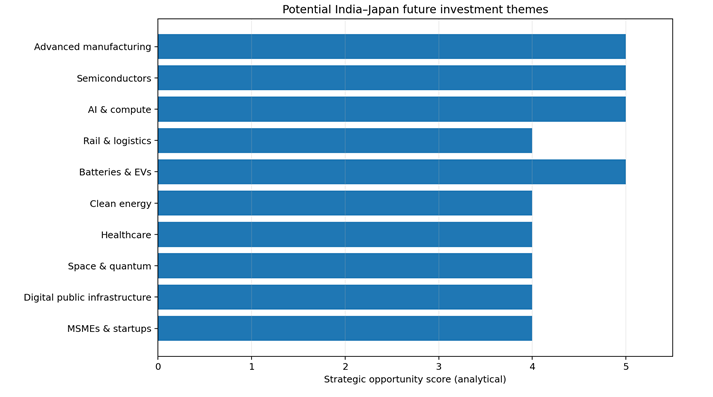
Finally, there is a risk of overconcentration in a few famous sectors. Automobiles and infrastructure are already well established, but the next investment cycle should diversify into electronics, AI, batteries, industrial software, healthcare, logistics, clean energy and advanced materials. Diversification reduces bilateral dependence on a small number of industries and increases the probability that the JPY 10 trillion ambition translates into broad-based economic capability.
12. A Practical Roadmap for 2026–2036
The first phase, 2026–2028, should focus on project preparation and ecosystem building. Governments and business associations should identify a portfolio of commercially viable projects in advanced manufacturing, semiconductors, AI infrastructure, batteries, logistics, healthcare and clean energy. Each project should have a named sponsor, location, financing structure, technology partner, customer pathway, workforce plan and implementation timetable. The objective is to create a pipeline rather than a collection of announcements.
The second phase, 2028–2031, should emphasize scale. Early projects that meet performance targets should be replicated across additional industrial clusters and states. Supplier-development programs should expand around successful anchor companies. AI and semiconductor research partnerships should move from pilot programs to commercial products. Joint startup funds should finance companies that can serve both markets. Infrastructure platforms should combine logistics, energy, data and industrial tenants.
The third phase, 2031–2036, should emphasize global competitiveness. By then, the goal should be for India–Japan partnerships to produce products and technologies for third-country markets. This could include automotive components, industrial robots, battery systems, medical devices, AI software, logistics platforms, clean-energy equipment and advanced materials. Joint ventures should evolve from India-market strategies into global supply-chain strategies.Across all three phases, measurement is critical. A useful dashboard should track Japanese investment committed and deployed, number of operating companies, local procurement, exports, jobs, R&D spending, patents, supplier certifications, energy intensity, renewable-energy use, training completions and startup investments. For AI, metrics should include compute capacity, joint research projects, model deployments, safety testing and cross-border talent. For manufacturing, metrics should include productivity, defect rates, localization and export share.Governance should be collaborative but commercially grounded. A bilateral public-private council can review progress, while sector-specific working groups solve operational problems. Indian states and Japanese prefectures should have a stronger role because many investment decisions are local. Industry associations can provide feedback from SMEs and suppliers. The most important principle is accountability: every announced initiative should have an owner, a deadline and a measurable output.The ultimate goal should be a self-reinforcing ecosystem. When one Japanese manufacturer establishes a successful plant, its suppliers should follow. When suppliers arrive, training centers should expand. When training expands, research partnerships become more viable. When research produces technology, startups can commercialize it. When products become competitive, exports increase and more investors arrive. This compounding effect is the real value of bilateral investment: not the first factory, but the network that grows around it.
13. Sector-by-Sector Investment Playbook
Advanced manufacturing: prioritize automotive components, industrial machinery, robotics, electronics, precision engineering and capital goods. Use Japanese quality systems and Indian engineering talent. Build supplier clusters rather than isolated factories. Encourage export-oriented plants and local R&D.
Semiconductors and electronics: focus on design, packaging, testing, power devices, sensors, materials, equipment services and electronics manufacturing. Build reliable power, water, logistics and talent infrastructure. Use joint R&D to create commercially relevant products rather than pursuing prestige projects without customer demand.
AI and data centers: develop regional AI infrastructure hubs with renewable power, fiber, data governance, cybersecurity and skilled operators. Combine Japanese hardware and infrastructure expertise with Indian software, data and startup capabilities. Prioritize industrial AI and public-interest applications alongside general-purpose compute.Mobility and logistics: expand rail, freight, ports, warehouses, cold chains, fleet electrification and intelligent transport systems. Connect physical infrastructure to digital platforms. Develop Indian suppliers for Japanese technology and create exportable components.
Batteries and clean energy: develop cell and component manufacturing, recycling, power electronics, charging, renewable generation, storage and hydrogen-related supply chains. Integrate energy security into industrial policy so that factories and data centers have reliable low-carbon electricity.
Healthcare and life sciences: pursue medical devices, diagnostics, digital health, elder care, pharmaceuticals, biotechnology and hospital technology. Combine Japanese precision with Indian cost-efficient manufacturing and healthcare scale.Agriculture and food processing: invest in cold chains, automation, food safety, packaging, precision agriculture and processing clusters. Use Japanese quality and post-harvest technologies to increase Indian agricultural value addition and exports.Startups and MSMEs: establish bilateral venture and growth funds, supplier-development programs, corporate accelerators and cross-border procurement channels. Help Indian startups enter Japanese corporate supply chains and help Japanese SMEs localize in India.
Infrastructure and urban development: create integrated industrial and smart-city zones with high-quality utilities, logistics, digital networks, worker services and low-carbon energy. Treat infrastructure as an ecosystem platform rather than a standalone construction project.
14. Strategic Outlook: What India and Japan Can Build Together
The strongest interpretation of the India–Japan investment relationship is that it is becoming a co-creation partnership. Japan does not simply provide capital and India does not simply provide market size. Both countries can contribute technology, talent, manufacturing capability, finance, infrastructure, research and entrepreneurship. The most valuable projects will combine these inputs into new production systems that neither country would build as efficiently alone.Manufacturing will remain the backbone because it creates physical capacity, supplier networks and export potential. But manufacturing is increasingly digital. Factories require AI, sensors, software, semiconductors, cybersecurity and reliable energy. That means the manufacturing opportunity automatically expands into the digital and infrastructure economies. Similarly, AI requires semiconductors, data centers, electricity and advanced cooling, which creates opportunities for industrial investment. These sectors are interconnected rather than separate.The 2026 AI agenda is especially important because it signals a shift toward infrastructure and joint research. Cooperation on compute, data centers, GPUs, semiconductors, talent and trustworthy AI creates a framework for a deeper technology relationship. If implemented effectively, India and Japan could build AI systems for industrial, healthcare, mobility and public-service applications that are optimized for Asian conditions and supported by secure supply chains.The investment target of JPY 10 trillion should therefore be treated as a catalyst, not merely a number. Its success should be judged by what the investment builds: factories, research centers, skilled workers, startups, suppliers, exports, digital infrastructure, energy capacity and resilient supply chains. If those capabilities grow, the economic relationship will become self-sustaining.
For India, the strategic prize is deeper integration into advanced global manufacturing and technology networks while creating jobs and domestic capability. For Japan, the prize is access to India’s growth and talent while diversifying production and building resilient markets. For the wider Indo-Pacific, the prize is a stronger network of trusted industrial and technology partnerships.The next decade can therefore be defined by a simple proposition: Japanese technology, capital and industrial discipline combined with Indian scale, talent, entrepreneurship and market opportunity can create a new model of Asian economic co-development. The opportunity is significant, but it will require patient capital, predictable policy, strong project execution, shared standards, workforce investment and continuous measurement. If those conditions are met, India–Japan investment can move from bilateral cooperation to a globally competitive platform for manufacturing, AI, infrastructure and sustainable growth.ConclusionIndia and Japan have the ingredients for a powerful next-generation investment relationship: established corporate networks, strategic trust, complementary economic strengths, growing technology cooperation and a clear political commitment to deeper investment. The new JPY 10 trillion private-investment target provides scale, while the 2025–2026 agreements provide direction across semiconductors, AI, digital infrastructure, mobility, batteries, clean energy and economic security.The practical challenge is execution. Projects must become bankable, factories must become globally competitive, technology partnerships must produce commercial products, training must create measurable skills and infrastructure must be designed around real industrial demand. The best outcomes will come from ecosystems that connect capital to manufacturing, manufacturing to suppliers, suppliers to skills, skills to research, and research to startups and exports.India–Japan investment can consequently become more than a bilateral economic story. It can become a platform for resilient Asian supply chains, advanced manufacturing, trustworthy AI, clean infrastructure and inclusive economic growth. The opportunity over the next decade is not simply to invest more, but to build better—and to build together.
Sources and Reference Notes
[1] Ministry of Foreign Affairs of Japan, Japan–India Summit Meeting and Working Dinner, 2025. Key point used: the earlier JPY 5 trillion public/private investment and financing target was achieved in three years and a new JPY 10 trillion private-investment target was set.
[2] Prime Minister of India, Press Statement during the joint press statement with the Prime Minister of Japan, 2025. Key point used: India and Japan set a 10-year JPY 10 trillion investment target and a broader roadmap covering investment, innovation, economic security, environment, technology and mobility.
[3] Prime Minister of India, 15th India–Japan Annual Summit Joint Statement, 2025. Key points used: industrial cooperation, Japan Industrial Townships, logistics, textiles, food processing, agriculture, automotive, industrial capital goods, MSMEs and review of CEPA implementation.
[4] Ministry of External Affairs, Government of India, India–Japan Bilateral Brief, 2025. Key points used: approximately US$43.2 billion Japanese FDI, about 1,400 Japanese companies and nearly 5,000 establishments, sector composition and JETRO survey findings.
[5] METI, Japan–India Digital Partnership 2.0, 25 August 2025. Key points used: semiconductors, AI, digital public infrastructure, digital talent, R&D and startup cooperation.
[6] JETRO, Invest Japan Report 2025. Key points used: Japan FDI trends, greenfield investment, data centers and logistics, manufacturing, inward investment policy and Japan’s 2030 FDI target.
[7] JETRO, Manufacturing sector overview. Key points used: Japan’s manufacturing strength, digitalization, decarbonization, semiconductors, industrial robots, automobiles and aerospace.
[8] Prime Minister of India, List of Outcomes: PM’s Visit to Japan, 2026. Key points used: JPY 10 trillion private-investment target, economic security initiative, India–Japan AI Initiative, next-generation mobility, SME forum and sustainable-fuel initiative.
[9] Prime Minister of India, India–Japan Joint Statement on cooperation in the field of Artificial Intelligence, 2 July 2026. Key points used: safe and trustworthy AI, strategic R&D partnership and cooperation on data centers, GPUs/compute and semiconductors.
[10] Ministry of Foreign Affairs of Japan, 1st Japan–India AI Strategic Dialogue, April 2026. Key point used: first bilateral strategic dialogue on AI with government and private-sector participation.
[11] METI, Japan–India AI cooperation memorandum, July 2026. Key points used: business matching, cross-border business support and information for advanced AI talent; 15 private-sector MoUs were also announced.
[12] METI, Japan–India battery cooperation memorandum, July 2026. Key points used: reliable battery supply chains, investment, technology cooperation, IP protection, regional stakeholders and safety/reliability.
[13] Prime Minister of India, IndiaAI Mission announcement. Key point used: IndiaAI Mission budget of Rs.10,371.92 crore and planned public AI compute infrastructure of 10,000 or more GPUs.
This report is an analytical synthesis of official public sources available as of September 2026. Forward-looking statements are strategic assessments, not guarantees of investment returns, government approvals or future market outcomes.Appendices Appendix A — Implementation Checklist for Investors For a Japanese company evaluating India, the first step is to define the strategic purpose of the investment. A company seeking market access should use a different model from one seeking export manufacturing, supply-chain diversification or technology development. The investment thesis should specify the target customer, expected localization, supplier strategy, workforce requirements, technology contribution, export potential and five-to-ten-year operating assumptions. A clear thesis makes it easier to choose between a greenfield project, acquisition, joint venture, strategic minority investment or partnership with an existing Indian company. The second step is location selection. Investors should compare states and industrial corridors using a common scorecard covering land, power reliability, renewable-energy availability, water, logistics, ports, airports, supplier density, labor availability, universities, incentives, environmental conditions and proximity to customers. Japanese companies may also value the presence of other Japanese firms because an existing cluster can reduce onboarding costs. However, clustering should not eliminate diversification; a company should evaluate supply-chain concentration and resilience before choosing a location. The third step is supplier development. Instead of waiting for local suppliers to emerge, anchor investors can identify strategic components and develop Indian vendors through technical training, quality certification, process improvement and financing. Supplier-development programs can be co-funded by the anchor company, financial institutions and public agencies. Over time, suppliers should be encouraged to serve multiple customers and export, reducing dependence on one buyer. The fourth step is workforce development. Each major project should publish a skills map covering engineers, technicians, operators, data specialists, maintenance staff, managers and safety personnel. Training should begin before plant commissioning, not after. Japanese companies can contribute standardized curricula and on-the-job methods, while Indian institutions can provide scale. Digital training can complement physical labs, but high-value industrial skills still require access to real machines and supervised practice. The fifth step is technology governance. Every joint project should specify what intellectual property is contributed, what is created jointly, who owns improvements, where data can be stored, how confidential information is protected and how technology can be commercialized in third countries. AI projects require additional controls around training data, model evaluation, cybersecurity, privacy and human oversight. Clear governance increases trust and reduces the risk that promising pilots become stuck in legal negotiations. The sixth step is financing. Investors should prepare base, upside and downside scenarios, including currency movements, input costs, energy prices, utilization, regulatory delays and demand changes. Projects that depend on a single optimistic assumption should be redesigned. Blended finance can be useful for infrastructure or first-of-a-kind technologies, but private sponsors should retain clear economic accountability. A project that cannot eventually generate sustainable cash flow should not be described as commercially proven merely because public support is available. The seventh step is export strategy. India-based Japanese projects should evaluate Southeast Asia, the Middle East, Africa and other markets from the design stage. Export requirements can influence product standards, packaging, certifications, logistics and supplier selection. Japanese global customer relationships can be an advantage, while Indian firms can provide cost competitiveness and local-market adaptation. Jointly developed products should be designed for multiple markets rather than being locked into one country’s specifications.The eighth step is measurement. Management teams should monitor capital deployed, production volume, localization, supplier count, defect rates, export share, R&D spending, training hours, employee retention, energy intensity and emissions. AI projects should additionally monitor compute utilization, model accuracy, safety incidents and business outcomes. Transparent metrics allow both governments and investors to distinguish real progress from announcements.
Appendix B — Key Questions for PolicymakersPolicymakers can accelerate India–Japan investment by reducing the transaction cost of doing business. The most valuable reforms are often operational: faster approvals, predictable standards, reliable utilities, transparent land processes, better logistics, easier customs procedures and consistent tax administration. Large incentive packages are less useful when investors cannot predict project timelines. Governments should therefore compete on execution quality as well as fiscal incentives.Policymakers should also design incentives around ecosystem outcomes. Instead of rewarding only capital expenditure, programs can reward local supplier development, R&D, export growth, workforce training, energy efficiency and technology commercialization. This encourages investors to create capabilities that persist after the initial incentive period. It also makes public support easier to evaluate.A second policy priority is cross-border talent. India and Japan should continue expanding technical training, internships, research exchanges and skilled-worker mobility. Visa and certification processes should be transparent and aligned with industrial needs. A semiconductor technician, robotics engineer or AI researcher should be able to participate in a bilateral project without unnecessary administrative friction.A third priority is standards cooperation. Different technical standards can fragment markets even when tariffs are low. India and Japan can align selected standards for batteries, industrial automation, medical devices, AI testing, cybersecurity, logistics data and digital systems. Harmonization does not require identical regulation; it requires enough interoperability that products and services can move across borders efficiently.A fourth priority is research commercialization. Joint research programs should include pathways to pilot production, startup formation and procurement. Universities can generate valuable technology, but commercial adoption requires industry partners, financing and testing facilities. Shared centers of excellence should therefore include corporate participation and clear commercialization metrics.Appendix C — Investor TakeawaysThe central takeaway is that India–Japan investment should be approached as a portfolio of connected opportunities. Manufacturing is the foundation; AI and digital infrastructure are accelerators; clean energy is an enabler; skills are the human infrastructure; and economic security is the strategic framework. Investors that connect these dimensions are more likely to capture the full value of the partnership than investors that view each project in isolation.The second takeaway is that timing matters. Bilateral policy has moved quickly in 2025 and 2026, with a new investment target, Digital Partnership 2.0, AI cooperation, economic-security initiatives, mobility cooperation and battery collaboration. Early participants can help shape standards, supplier networks and talent ecosystems. Later participants may benefit from more mature infrastructure but face stronger competition.The third takeaway is that the strongest opportunities are likely to be those that solve real operational problems. AI that reduces factory downtime, robotics that addresses labor shortages, batteries that lower mobility costs, logistics systems that shorten delivery times, medical devices that reduce healthcare costs and clean-energy systems that improve power reliability all have clearer commercial logic than technology projects based mainly on strategic branding.The fourth takeaway is that trust is a productive asset. Long-term investment depends on confidence in contracts, intellectual property, data governance, safety, quality and policy continuity. India and Japan have accumulated considerable strategic trust; the next task is to translate that trust into repeatable commercial mechanisms. If they succeed, the bilateral investment relationship can become one of the most important technology-and-manufacturing partnerships in the Indo-Pacific.
Selected Online Sources
Institution Source URL
Japan MOFA Japan–India Summit Meeting and Working Dinner (2025) https://www.mofa.go.jp/s_sa/sw/in/pageite_000001_00005.html
Prime Minister of India 15th India–Japan Annual Summit Joint Statement https://www.pmindia.gov.in/en/news_updates/15th-india-japan-annual-summit-joint-statement-partnership-for-security-and-prosperity-of-our-next-generation/
MEA India India–Japan Bilateral Brief (2025) https://www.mea.gov.in/Portal/ForeignRelation/India-Japan-May-2025.pdf
METI Japan Japan–India Digital Partnership 2.0 https://www.meti.go.jp/english/press/2025/0829_004.html
JETRO JETRO Invest Japan Report 2025 https://www.jetro.go.jp/en/invest/investment_environment/ijre/report2025/
JETRO Manufacturing in Japan https://www.jetro.go.jp/en/invest/attractive_sectors/manufacturing/
PM India List of Outcomes: PM’s Visit to Japan (2026) https://www.pmindia.gov.in/en/news_updates/list-of-outcomes-pms-visit-to-japan/
PM India India–Japan Joint Statement on AI (2026) https://www.pmindia.gov.in/en/news_updates/india-japan-joint-statement-on-cooperation-in-the-field-of-artificial-intelligence-ai/
Japan MOFA 1st Japan–India AI Strategic Dialogue (2026) https://www.mofa.go.jp/press/release/pressite_000001_02290.html
METI Japan India–Japan AI Cooperation MoC (2026) https://www.meti.go.jp/press/2026/07/20260703003/20260703003.html
METI Japan India–Japan Battery Cooperation MoC (2026) https://www.meti.go.jp/press/2026/07/20260702002/20260702002.html
Appendix D — Detailed Future Investment Themes and Commercial Models
The most attractive future projects are likely to be those that combine at least two strategic capabilities. A manufacturing project connected to AI can improve productivity and create software intellectual property. A battery project connected to renewable power can reduce energy risk and emissions. A semiconductor packaging facility connected to an Indian design ecosystem can create a pipeline of customers. A logistics platform connected to industrial parks can lower supply-chain costs for multiple investors. This integrated approach is important because investment returns increasingly depend on ecosystems rather than isolated assets.
One promising model is the Japanese technology–Indian scale partnership. Under this structure, a Japanese company contributes equipment, process know-how, product specifications, quality systems and access to global customers, while an Indian partner contributes local manufacturing, engineering, procurement, workforce management and market access. The partnership can be organized as a joint venture or a long-term supplier agreement. The key is to establish clear milestones for localization, productivity, exports and technology development.A second model is the industrial-platform approach. Instead of investing in a single factory, a consortium develops an industrial campus containing manufacturing units, logistics facilities, renewable power, worker services, training centers, testing laboratories and digital infrastructure. Japanese anchor companies can attract suppliers, while Indian developers provide local execution. Such platforms can lower costs for smaller Japanese companies that would otherwise find it difficult to establish an independent presence in India.
A third model is the bilateral technology venture. An Indian startup and a Japanese corporate partner can create a new company focused on an industrial problem such as robotics, factory AI, predictive maintenance, battery management or healthcare automation. The Japanese partner contributes domain knowledge and enterprise customers; the Indian startup contributes software, AI talent and speed. The new company can then sell globally. This model is particularly attractive where the traditional procurement relationship is too slow for rapidly changing technologies.A fourth model is the research-to-manufacturing pipeline. Universities and research institutes on both sides identify a technology with commercial potential, while companies participate from the beginning. A joint lab develops prototypes, a pilot facility validates the technology and an investment vehicle funds scale-up. This reduces the common problem in which research partnerships produce papers but not products. Semiconductor materials, advanced batteries, industrial AI, quantum applications and medical devices are suitable candidates.
A fifth model is strategic infrastructure co-investment. Data centers, renewable power, industrial parks, ports, logistics facilities and high-speed rail require large amounts of capital and long investment horizons. Japanese institutional investors can participate alongside Indian infrastructure companies and public agencies. Revenue can come from multiple tenants or users rather than one customer. Risk can therefore be diversified across an ecosystem. Strong governance and transparent contracts are essential for such structures.
In advanced manufacturing, investors should prioritize products with repeatable demand and high learning potential. Examples include automotive electronics, power modules, sensors, robotics components, machine tools, medical devices and industrial control systems. These products allow factories to improve through volume and process learning. They also create opportunities for Indian suppliers to move from basic components to higher-value assemblies. Japanese quality management can accelerate that transition.
In AI, the commercial opportunity should be segmented carefully. General-purpose model development requires enormous compute and capital, but many profitable opportunities exist below that level. Industrial AI, enterprise knowledge systems, Japanese-language and Indian-language applications, healthcare AI, logistics optimization, quality inspection and intelligent maintenance can all generate value without requiring a company to build a frontier model from scratch. India–Japan cooperation can therefore target practical AI deployment while also supporting strategic research.Data-center investment should be evaluated as an energy-and-network project as much as a computing project. Investors need reliable electricity, diverse fiber routes, efficient cooling, water availability, backup systems, cybersecurity and access to customers. Renewable energy can improve long-term cost and carbon performance, but intermittency must be managed through storage, grid access or firm power arrangements. Japanese engineering firms can contribute high-reliability equipment and operations, while Indian developers can provide sites and local infrastructure.
For batteries and electric mobility, the commercial question is not simply how many cells can be produced. Investors must consider chemistry, vehicle segment, warranty requirements, thermal conditions, recycling, charging infrastructure and raw-material security. India can provide a large demand base, but cost competitiveness will require efficient local supply chains. Japanese technology and quality assurance can be especially valuable in applications where safety and lifecycle performance are more important than the lowest initial price.
Clean-energy cooperation should also include industrial efficiency. Japan has long experience in energy-saving manufacturing, while India has a large installed base of factories that can benefit from modernization. Joint ventures can offer energy audits, high-efficiency motors, heat recovery, smart controls, efficient cooling and process optimization as a service. Instead of requiring every factory to make a large upfront investment, service companies can finance improvements and recover the cost through verified energy savings.
Healthcare investment can benefit from a similar service model. Rather than focusing only on hospitals or pharmaceutical factories, investors can build integrated diagnostic, remote-care and elder-care platforms. Japanese medical technology can be combined with Indian software, telemedicine and clinical networks. The model can scale across cities and eventually into other emerging markets. Strong clinical governance, privacy and patient safety should remain central to the business design.
Agricultural technology is another area where a partnership can become globally relevant. Japanese precision equipment, sensors, packaging and quality systems can be adapted to India’s varied agricultural conditions. Indian agritech companies can provide farmer networks, data platforms and local operations. Joint solutions can reduce post-harvest losses, improve traceability and raise export quality. Food-processing clusters can become anchors for rural industrialization, creating value closer to production regions.
The regional dimension is important. Investment should not be concentrated only in the largest metropolitan areas. Different Indian states can specialize according to industrial strengths, ports, renewable-energy resources, workforce availability and market access. Japanese prefectures can develop direct partnerships with Indian states, universities and industry associations. Such state-prefecture cooperation can shorten decision cycles and help smaller firms find appropriate locations and partners.
The same principle applies within Japan. Indian companies should not view Japan only through Tokyo. Regional manufacturing clusters, universities, technology centers and specialized suppliers offer opportunities for Indian firms seeking advanced capabilities. Indian software companies can partner with Japanese industrial firms, while Indian pharmaceutical, food and engineering companies can use regional Japanese networks to enter specialized markets. Two-way investment can make the relationship more balanced and resilient.
Environmental, social and governance considerations should be integrated into investment decisions. Industrial projects need credible plans for emissions, water, waste, worker safety and community engagement. Japanese investors often have strong internal standards, while Indian regulation is evolving rapidly. Joint projects can use transparent sustainability metrics and third-party verification. This can improve access to international capital and reduce operational risk.For investors, the most useful decision framework is a five-part test. First, does the project solve a real market problem? Second, does it use complementary India–Japan capabilities rather than simply duplicating them? Third, can the project become competitive without permanent subsidy? Fourth, does it create a wider supplier, skills or technology ecosystem? Fifth, can the resulting product or service reach third-country markets? Projects that score strongly across these dimensions are more likely to create durable value.
For governments, the equivalent test is whether public support produces additionality. If an investment would happen without support, the subsidy may have limited incremental value. If support unlocks a strategically important capability that private investors cannot finance alone, it can be justified. Policy should therefore focus on infrastructure, skills, R&D, early-stage risk and coordination where market failures are strongest, while leaving mature commercial operations to private capital.
For companies, the final lesson is patience combined with speed. Strategic partnerships often require years to develop because trust, technology qualification and supplier networks take time. At the same time, AI, batteries and digital infrastructure evolve rapidly, so companies cannot wait for every uncertainty to disappear. A staged investment model is useful: start with a pilot, define measurable milestones, expand when evidence is positive, and preserve options when technology or market conditions change.
Taken together, these commercial models show how the India–Japan relationship can move from individual transactions toward a portfolio of connected platforms. The next decade will likely reward investors that can integrate manufacturing, technology, infrastructure, energy and talent. The bilateral partnership already provides political direction; the commercial task is to build repeatable mechanisms that turn that direction into factories, research programs, startups, infrastructure assets and globally competitive products.
Contents
Executive Summary
1. The India–Japan Investment Relationship: From Partnership to Production Ecosystem
2. Why Manufacturing Is the Core Opportunity
3. Semiconductors, Electronics and Strategic Supply Chains
4. Artificial Intelligence and the New Digital Infrastructure Economy
5. Infrastructure, Mobility, Logistics and Smart Cities
6. Batteries, Electric Mobility and Clean Energy
7. Healthcare, Pharmaceuticals, Agriculture and Human-Centered Growth
8. Skills, Talent Mobility, Startups and MSMEs
9. Economic Security and Supply-Chain Resilience
10. Financing the Next Decade of India–Japan Investment
11. Risks, Constraints and What Could Slow the Opportunity
12. A Practical Roadmap for 2026–2036
13. Sector-by-Sector Investment Playbook
14. Strategic Outlook: What India and Japan Can Build Together
Conclusion
Appendices