- Head (Mantle)
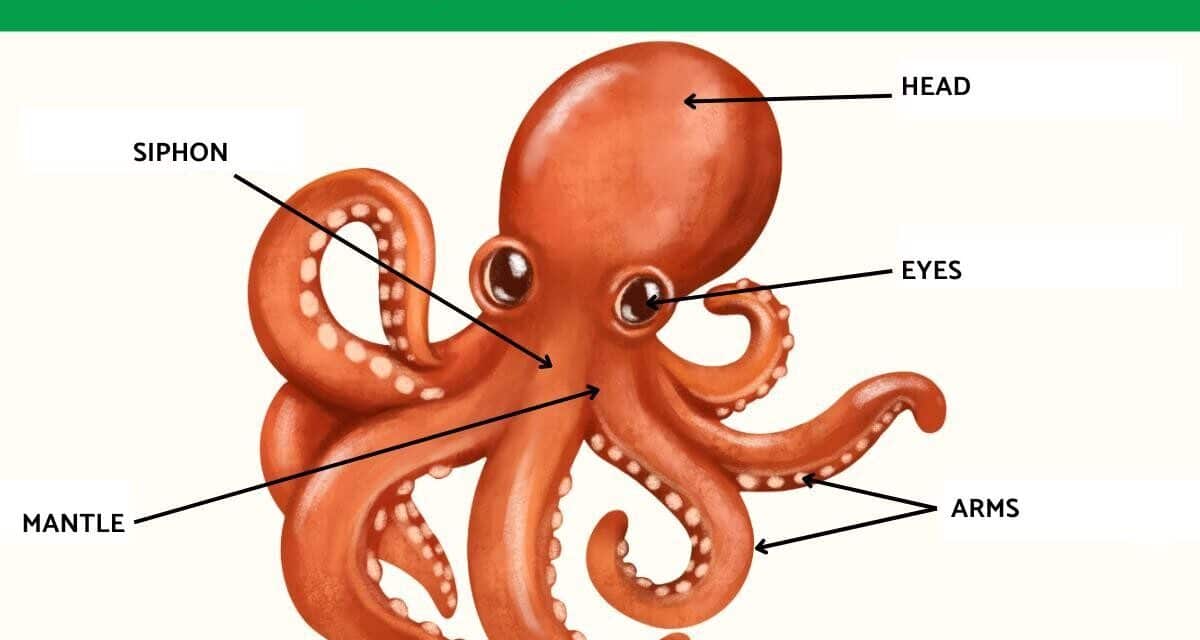
An octopus’s “head“ area (cephalon) primarily houses its complex brain (donut-shaped, encircling the esophagus), large eyes, and mouth with a sharp, parrot-like beak for biting prey, surrounded by its eight arms, while the bulging part behind it is the mantle, containing vital organs like gills, hearts, and the ink sac, with the funnel/siphon used for jet propulsion.
Key Head & Mouth Structures:
Brain: A central brain (with lobes in arms) controls activities, doughnut-shaped around the esophagus.
Eyes: Large, sophisticated camera-like eyes, located on the head.
Mouth & Beak: A strong, chitinous beak for crushing prey, with a toothed tongue (radula) inside, situated at the center where arms meet.
Buccal Mass: The muscular structure housing the beak and radula.
Connected to the Head/Mantle:
Arms: Eight muscular limbs with suckers, used for movement and catching food, with their own mini-brains.
Mantle: The bulbous body/torso behind the head, containing organs like gills, hearts, digestive gland, and reproductive organs, used for breathing and propulsion.
Funnel (Siphon): A muscular tube used to expel water for jet propulsion and ink release.
Ink Sac: Contains melanin, connected to the siphon for defense.
2.Eyes
Octopus eyes are complex, camera-like organs with a cornea, iris, adjustable lens, and a light-sensitive retina, allowing excellent underwater vision, though they see in black and white; key features include pupils that change shape for light, a unique “flipped” retina (no blind spot), and light-focusing via lens movement, not shape change, with light-sensing skin aiding camouflage and navigation. Key Parts of the Octopus Eye
Cornea: A transparent outer layer protecting the eye and helping focus light.
Iris: Surrounds the pupil and controls its size, adapting to light.
Pupil: Can dilate (widen) in dim light and constrict (narrow) in bright light, often forming a distinctive slit shape, unlike most fish.
Lens: A spherical, internal lens that moves forward or backward to focus images, similar to a camera.
Retina: Contains photoreceptors that detect light but are oriented differently (everted) than in humans, facing the light source, which eliminates the blind spot. Optic Nerve: Transmits visual signals to the brain.
3.Arms (Eight Tentacles)
An octopus’s arm is a sophisticated “muscular hydrostat” with no bones, featuring complex muscle groups (longitudinal, transverse, oblique) for movement, a central axial nerve cord for control, and suckers for grip, taste, and touch, allowing incredible flexibility for hunting, exploring, and manipulating objects. Key components are the three muscle types, the axial nerve cord with ganglia, and the highly sensitive suckers, all working together without a skeleton.
Key Anatomical Parts of an Octopus Arm: Musculature:
Longitudinal Muscles: Run parallel to the arm, contracting to shorten and thicken the arm.
Transverse Muscles: Perpendicular to the arm’s length, contracting to narrow the arm.
Oblique Muscles: Helically wound around the arm, allowing for complex twisting and bending.
4.Suckers
The main parts of an octopus’s anatomy are its mantle, head, and eight arms. The arms are lined
5. with numerous suckers, which are complex organs used for locomotion, manipulation, and sensing the environment.
6.Three HeartsTwo branchial hearts pump blood through gills.
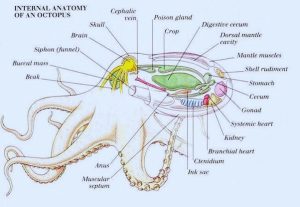
An octopus’s main anatomy includes a central mantle, eight arms with suckers, a beak, and a complex nervous system with a central brain, but its unique feature is three hearts: two branchial hearts pump blood through the gills for oxygen, while a larger systemic heart circulates oxygenated blood to the body, stopping when swimming, making them prefer crawling.
7.Beak
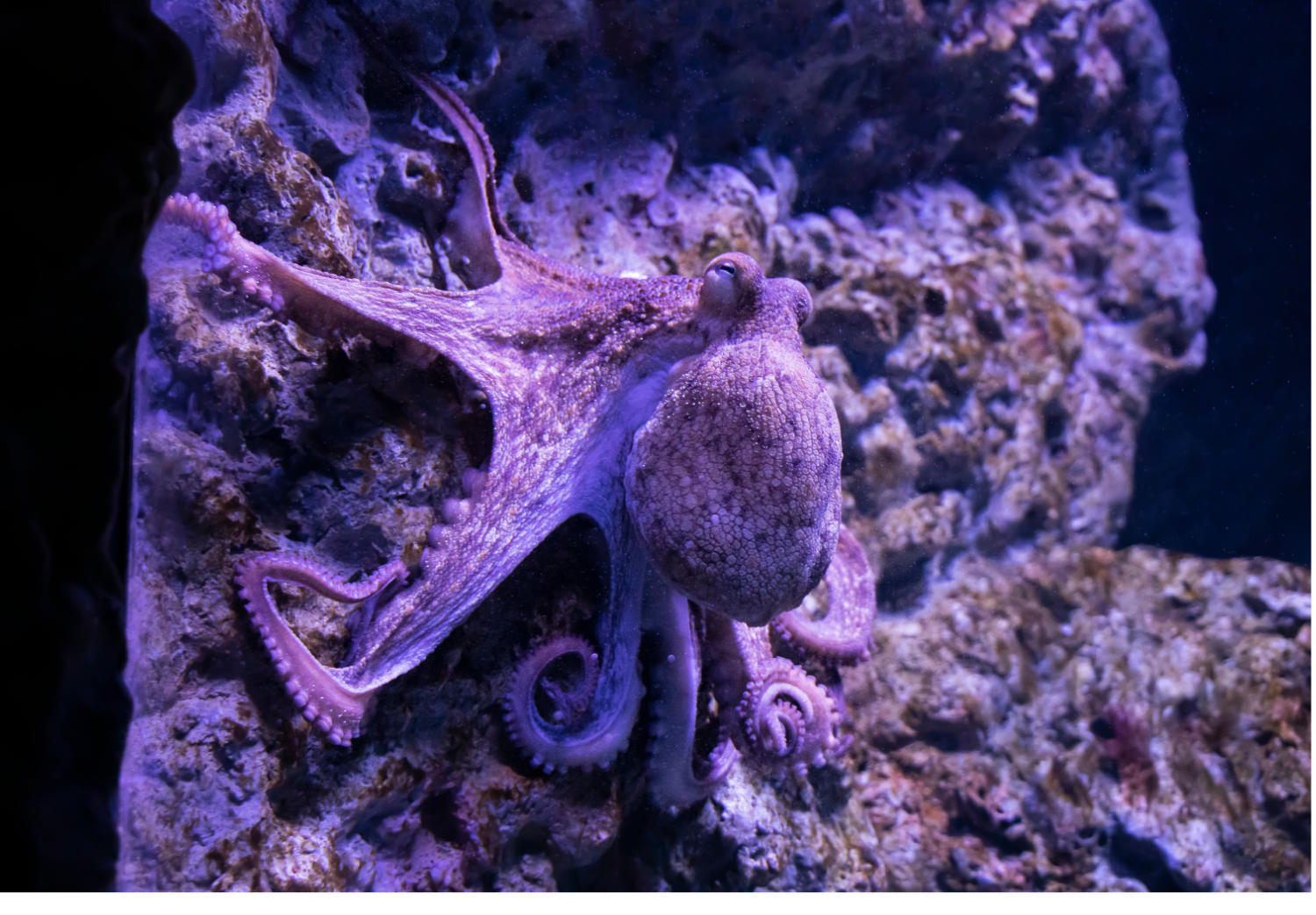
The back of an octopus is dominated by the muscular, bulbous Mantle, a sac housing vital organs like the gills (for breathing), three hearts, digestive organs, and reproductive glands, expelling water via the Siphon (or funnel) for jet propulsion and respiration, while its incredible skin uses pigments (chromatophores) for camouflage and communication. The body is soft, lacking a backbone, allowing it to squeeze through tight spaces, with its head containing the brain and beak, and its eight arms extending from the base.
8.Ink Sac
Connected to the digestive system. Produces ink cloud to escape predators.
9.Skin & Chromatophores
Octopus skin contains:,Chromatophores → color-changing cells,Iridophores → reflective cells,Leucophores → light-scattering cells,Together, they allow:,Camouflage, Communication,Texture change
10. Siphon (Funnel)
Tube-like structure under the mantle.,Used for:,Jet propulsion,Expelling waste,Releasing ink
Poison And Nervus System
Another gland that they have is to create and hold their venom. That is what they inject into their prey to immobilize it. Without this process, they would have a hard time getting their prey to be still. They rely upon their powerful beak to be able to break the shells of their prey. When they can’t, they have a very powerful sucking ability to take it out of the shell.
The nervous system for an Octopus is controlled by the brain, and it is very complex in nature. What is very interesting is that they don’t have any organs for hearing. The octopus is an animal that is deaf. They have a sac where the ink is produced when they need to release it and escape from danger.
There is actually a gland in the body that creates it. The amount of ink depends on the species of Octopus and the overall size.
There are several different types of movement that the Octopus is able to enjoy due to its overall anatomy. They are often seen walking around at a leisurely pace. They can also crawl by bending the arms at different angles.
They will swim rapidly to avoid danger or to be able to capture their own prey. They also have jet propulsion when they need to flee due to impending dangers so they can go extremely fast.
The vision for an Octopus is very good and they use it to help them move around in the water. They also rely upon their sight to keep a good lookout for various types of predators.