

Analysis: Life sciences winners and losers in the global economy

SCIs economist Rena Halpenny looks at the international race for life sciences companies – and which countries are winning.
Life sciences firms are a critical asset for any major economy; the pharmaceutical industry has contributed over $2tn to world GDP and accounted for 75m jobs globally in 2022, both directly and through wider spillover effects.

These are businesses that create good jobs, support a wider ecosystem of suppliers and can be a key indicator of the industrial momentum of a particular economy. As such, countries of all sizes are looking to attract – and retain – life science companies to boost their economies and to support broader objectives like building national resilience.

The benefits of a thriving life science industry are widely recognised, and the global race to attract life science companies has gained new momentum as global supply chains come under pressure. The US, in particular, is becoming increasingly explicit about its desire to have pharma businesses moving more of their operations there.That’s in part because, while North America is certainly the biggest market for pharmaceuticals sales – accounting for 55% of all sales – only about 10% of the active pharmaceutical ingredients by volume for the finished drug products used in the US are actually made there.

Pharma manufacturing and R&D are extremely global. So, according to the data, who are countries leading the race and how have they done it?

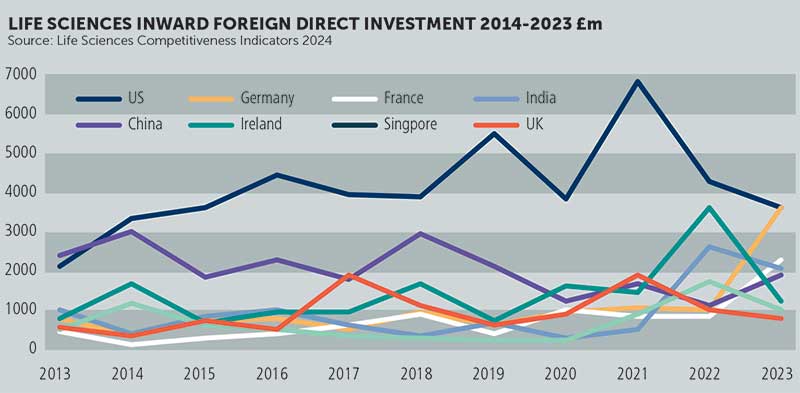
Germany, Switzerland, the US and Ireland are among the biggest exporters of pharmaceuticals (and the US is the biggest importer). The US, Germany, France, India, China and Ireland were the top six recipients of foreign direct greenfield investment in life sciences in 2023.

Life Sciences Winners and Losers

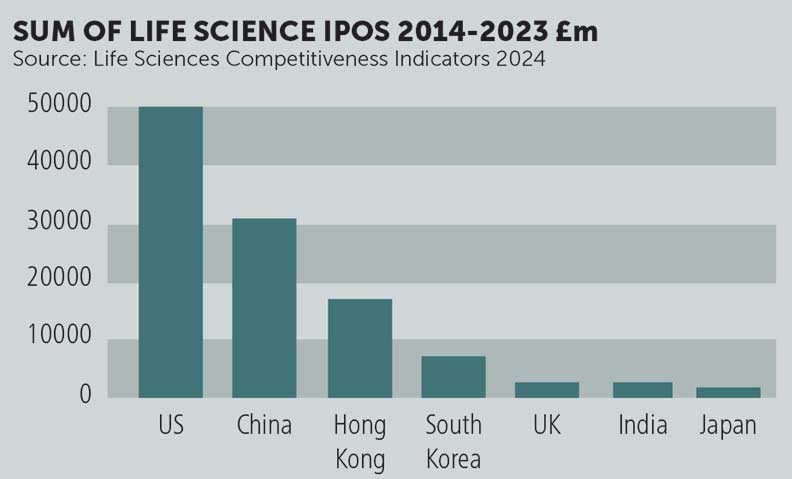
Globally, the US, China and Hong Kong saw substantial life science IPO activity between 2014 and 2023. For example, while the US economy is around seven times the size of the UK, the US raised nearly 18 times more than the UK in life science IPOs between 2014 and 2023, China raised nearly 11 times more than the UK while Hong Kong, which has an economy around a tenth the size of the UK, raised six times more. Meanwhile, pharma R&D investment in China is now outpacing both the US and Europe by a significant margin, according to data from the European Federation of Pharmaceuticals Industries and Associations.

And it’s clear that, for some countries, the life sciences industry is playing an outsized role in their economy. For a country like Switzerland, its pharma strength has for a long time been a key contributor to its growth: pharmaceutical exports in Switzerland account for around 30% of total exports and the value of all exports of goods and services is equivalent to just over 70% of Swiss GDP. Switzerland is home to two of the top global pharmaceutical companies: Roche and Novartis. The UK is also home to two top pharma companies, AstraZeneca and GSK, but the growth contribution of pharma to the UK economy is currently much less.

There is clear evidence that a thriving life sciences sector can reap dividends for an economy – and changing the path of an economy to better support life sciences is entirely possible.

For example, over the last 25 years, Ireland has created an investment-friendly economic environment, which has resulted in pharmaceuticals providing a big part of the country’s growth momentum.

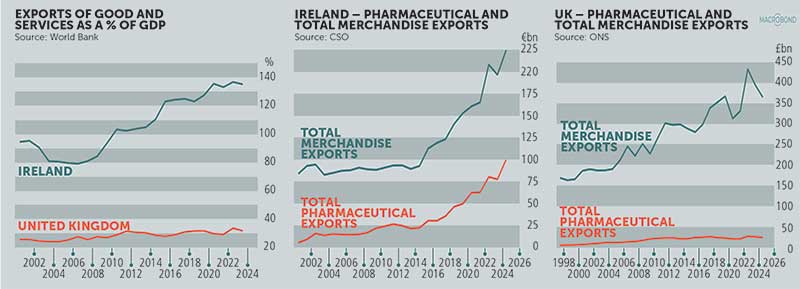
In 2024, Irish exports of medicinal products and pharmaceuticals accounted for over 40% of all merchandise exports, rising from around 6% in 2000, outstripping other countries.

Low rates of corporate tax, plus generous R&D tax credits, tax relief on the acquisition of IP and more have all helped support this development in Ireland.

We can see from the graphs the significance of exports in Ireland’s economy and particularly pharmaceutical exports in that its growth trend mirrors the path for total merchandise exports.

Comparing the economic growth rates of both countries also highlights how influential the life science sector has been in supporting the Irish economy. In the last two decades, Ireland’s GDP growth has averaged over 5% reflecting the positive influence of life sciences in the Irish economy.
Life Sciences Winners and Losers

Pharmaceuticals have so far largely avoided being targeted with tariffs by US (although this may soon change) indeed, it’s partly the ability for countries to drive economic growth by providing a base for pharma companies, which has attracted the displeasure of the US Administration.

The US interest in tariffs reflects the fact that, despite the US being a major player in the pharmaceutical industry, it is running a large pharmaceutical trade deficit, while competitors, including Ireland, Switzerland and Germany, have been recording huge pharmaceutical trade surpluses.

North America accounted for over 50% of all global pharmaceutical sales in 2022, although this reflects the scale of this economic area. The European countries (including the UK) accounted for around 22% of global sales, China 8.1% and Japan 4.9%.

Many countries want to boost the prospects of their local life science companies and attract more investment from overseas while also preventing the leakage of innovation wealth.

The UK is the latest country to set out how it plans to do this, but it by no means alone; the US CHIPS and Science Act – as well as the more recent enthusiasm for tariffs in the White House – is another example. In July 2025, the European Union unveiled its own strategy aimed at making the EU the most attractive place for life sciences businesses by 2030, backed with over €10bn from EU funding programmes. And, after a few years of disruption, green shoots are emerging in terms of investment in China’s life sciences sector, according to consultant, LEK, with funding from the Natural Science Foundation of China returning to growth last year. China is also becoming an increasingly important source of R&D for companies seeking to license-in antibody-drug conjugates and other novel oncology treatments, according to research from consultant EY earlier in 2025.

The UK’s recently published Modern Industrial Strategy policy paper seeks to create the conditions under which by 2030, the UK can become the leading life sciences economy in Europe, and by 2035, the third most important life sciences economy behind the US and China. In its favour, the UK has four of the top ten universities for life sciences and medicine and ranks third after the US and China in terms of global medical sciences academic citations.
Life Sciences Winners and Losers

But, as the world moves away from globalisation to a new trading order it remains to be seen who will win out in the battle to attract and retain pharmaceutical investment.

During the 1980s, economists began to observe a trend of rising income inequality in the advanced industrial economies. At the same time, the data revealed that these economies were becoming increasingly exposed to imports of manufactured goods from developing countries. The question that follows is whether these outcomes are causally related, as economic theory suggests is possible. The literature under review represents the current thinking on that question. These studies, all by mainstream economists, accept that free trade makes for good policy, since it results in efficiency gains that are enjoyed by consumers. But these scholars also recognize that free trade can alter the returns to the factors of production, creating new patterns of winners and losers. Although this body of literature provides an impressive display of technical skills and formal economic reasoning, and on the whole gives convincing evidence that trade is only one culprit among many in explaining the problems facing blue-collar workers, it still sheds relatively little light on the political economy of the outcome. That is, it tells us little about the role that political, economic, and labor market institutions might play in shaping factor returns. This deeper understanding requires that we take a fresh look at existing institutions and the material interests and ideas underpinning them. Only then will we discover why societies have allowed a certain group of citizens-mainly the least skilled and least educated-to fall by the economic wayside.

Journal Information
International Organization is a leading peer-reviewed journal that covers the entire field of international affairs. Subject areas include: foreign policies, international relations, international and comparative political economy, security policies, environmental disputes and resolutions, European integration, alliance patterns and war, bargaining and conflict resolution, economic development and adjustment, and international capital movements. Guidelines for Contributors at Cambridge Journals Online

Among the largest university presses in the world, The MIT Press publishes over 200 new books each year along with 30 journals in the arts and humanities, economics, international affairs, history, political science, science and technology along with other disciplines. We were among the first university presses to offer titles electronically and we continue to adopt technologies that allow us to better support the scholarly mission and disseminate our content widely. The Press’s enthusiasm for innovation is reflected in our continuing exploration of this frontier. Since the late 1960s, we have experimented with generation after generation of electronic publishing tools. Through our commitment to new products—whether digital journals or entirely new forms of communication—we have continued to look for the most efficient and effective means to serve our readership. Our readers have come to expect excellence from our products, and they can count on us to maintain a commitment to producing rigorous and innovative information products in whatever forms the future of publishing may bring.

Life Sciences Winners and Losers Life Sciences Winners and Losers Life Sciences Winners and Losers Life Sciences Winners and Losers Life Sciences Winners and Losers Life Sciences Winners and Losers Life Sciences Winners and Losers Journal Information Journal Information Journal Information Journal Information Journal Information Journal Information Journal Information

Leave a Comment

Your email address will not be published. Required fields are marked *