
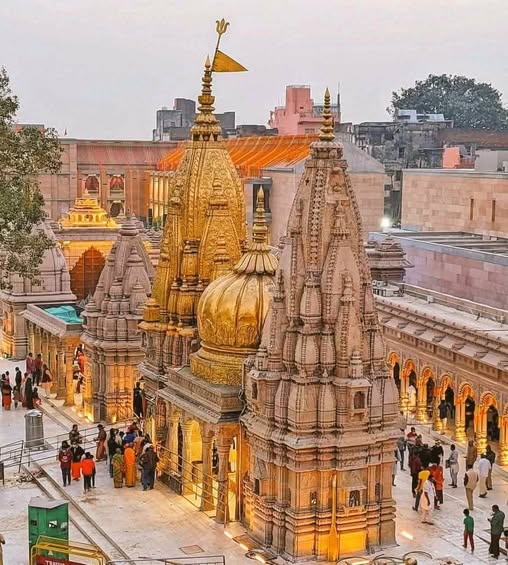
The story of the Shri Kashi Vishwanath Temple involves Shiva manifesting as a fiery pillar of light (Jyotirlinga) to end an argument between Brahma and Vishnu about who was supreme
Also known as the Golden Temple, it is dedicated to Lord shiva, the presiding deity of the city. Varanasi is Said to be the point at which the first jyotirlinga, the fiery pillar of light by which shiva manifested has supremacy over others gods, broke through the Earth’s crust and flared towards the heavens. More than the Gaths and even the Ganga, the Shivalinga installed in the temple remains the devotional focus of Varanasi.
MAA ANNAPURNA TEMPLE History
Near the Kashi Vishwanath temple, there is a nice temple of Devi Annapurna , believed as the “Godess of Fooding”.
SANKATHA TEMPLE
Near the Sindhia Ghat , there is a important temple of “Godess of Remedy” Devi Sankatha. Inside its premises there is a huge statue of a Lion. Also there is nine temples of nine planets nearby to this temple.
KALBHAIRAV TEMPLE
It is the ancient temple of Varanasi near the Head Post Office, VishesharGanj. God KalBhairav is believed as “Kotwal Of Varanasi” , without his permission no one can stay in Kashi.
MRITUNJAY MAHADEV TEMPLE
On the route of Daranagar to Kalbhairav temple this temple of Lord Shiva is situated . Just besides this temple there is a Well of much religious importance , whose water is said to be mixture of several underground streams and good for eliminating several diseases.
NEW VISHWANATH TEMPLE
Situated in the premises of Banaras Hindu University, a modern place of worship planned by Pandit Malviya and built by the Birlas. Open to all, irrespective of caste or creed.
TULSI MANAS TEMPLE
Constructed by family of Varanasi, this modern temple is dedicated to Lord Rama. It is situated at the place Where Tulisdas, the great medieval seer, lived and wrote the epic “Shri Ramcharitmanas”, which narrates the life of Lord Rama, the hero of the Ramayana. Verses from Tulidas’s epic are inscribed on the walls. It is just nearby to Durga Temple.
SANKATMOCHAN TEMPLE
Besides the Assi river stream, on the way of Durga Temple to Banaras Hindu Temple this well known temple of Lord Hanuman is situated. Lord Hanuman is also known as “Sankatmochan” the god who protects from the troubles. This temple is founded by Goswami Tulsidas. This temple is also known as “Monkey” temple, as lot of monkeys are there inside the premises.
DURGA TEMPLE
Commonly called the ‘Monkey temple’, it was built in the 18th century. Although it is one of the best-known temple. There is nice stonework done of the temple , it is the nice example of NAGRA Shilp. Godess DURGA is believed as the symbol of Strength and Power which govern the entire world. There is a pond adjacent to the temple called “Durgakund”.
BHARAT MATA TEMPLE
This Temple was inaugurated by Mahatma Gandhi in 1936 and houses one perfect relief maps of India carved out of marble.The Temple was gifted by the nationalists Babu Shiv Prasad Gupta (Barat Ratana ) and shri Durga Prasad Khatri, leading numismatists and antiquarians.
Shri Durga Temple
The temple is built around a holy pond called Durga Kund, which is considered sacred. Devotees often take a ritual bath in the kund before entering the sanctum, following traditional purification practices. The idol of Goddess Durga is depicted in her fierce yet protective form, standing with ten hands holding divine weapons, symbolizing her ability to combat evil and safeguard her devotees.
Durga Mata Mandir holds special significance during the festival of Navratri, when the temple is decorated with lights and flowers, and devotees gather in large numbers for prayers, chanting, and rituals. Apart from its religious importance, the temple is also an architectural gem, reflecting the traditional North Indian temple style with intricately carved pillars and a beautifully designed sanctum.
Ratneshwar Mahadev Temple – Kashi Karvat
Step carefully, and you’ll find yourself beside the Ganga, before a leaning Shiva temple— tilted by nearly nine degrees, more than Italy’s famed tower at Pisa. Locally called Kashi karvat or leaning of Kashi’, this temple carries a story steeped in devotion—and perhaps, a curse.
Legend says a devoted servant built the temple for his mother Ratna Bai. Proud of repaying her debt, he named it after her—only for Ratna Bai to curse it, saying maternal debt is eternal. Soon, the temple began to tilt. While earlier 19th-century drawings show the temple upright, by the 20th century the lean became visible.
Built in classic Nagara style by Aman Dev near Scindia Ghat, its sanctum often remains submerged, rising and dipping with the river’s moods. Priests would dive into the water to perform rituals when the entrance was underwater. Structural experts believe the tilt arises from a weak, silted foundation, combined with years of Ganga erosion and river currents. A lightning strike in 2016 even damaged parts of the shikhara.
Bindu Madhav Temple
the name Bindu Madhav or ‘drop-Lord.’ The temple became one of the revered Pancha Madhava shrines, places believed to cleanse karmic stains through devotion and grace.
Historically, this was once a grand temple praised by the 17th-century French traveller Tavernier, who described a cross-shaped pagoda with a six-foot jewelled idol of Vishnu, garlanded in rubies and pearls. In 1669, the temple was destroyed, yet the idol was secretly safeguarded, later recovered and reinstalled in a modest 19th-century shrine commissioned by Maratha ruler Bhavan Rao.
Today, the shrine holds a shaligram Vishnu idol, flanked by images of Garuda and Hanuman — possibly rescued from the ruins. Within its low-ceilinged hall, pilgrims gather for kirtan and japa, finding here a moment of refuge amid the city’s ebb.
Chandravati Jain Temple, Varanasi
The temple preserves the spiritual legacy of Lord Chandraprabhu, enshrining his idol in a peaceful sanctum. Its tranquil atmosphere, away from the bustle of the city, offers devotees a place for prayer, meditation, and reflection. The temple is also a reminder of Varanasi’s unique role as a center of faith for multiple religions, with Jainism holding a deep and historical connection to the region.
Pilgrims often visit Chandravati Jain Temple along with the other major Jain shrines in Varanasi and Sarnath, making it an integral part of the Jain pilgrimage circuit of Kashi.
Shitala Mata Mandir
The temple’s history ties closely to riverside devotion: the ghat was built in the 18th century by Queen Ahilyabai Holkar and later maintained by the Maharaja of Bundi; the temple itself dates from the mid-19th century, standing resilient amid both floods and faith.
Beyond architecture, this shrine holds deep social meaning: as smallpox gave way to other ailments, Shitala’s role evolved—today, she’s invoked for relief from fevers and respiratory distress, including tuberculosis.
Batuk Bhairav Temple
The tiny temple is known for its continuous oil lamp – Akhand Deep. Devotees believe the lamp’s oil, steeped in sacred presence, has healing powers — even used to treat wounds or animal bites. Around the shrine, dogs linger, believed to be the deity’s vahanas — their soft barks said to echo sacred resonance during evening rituals.
Open daily from early morning until late evening, it’s customary to complete a small circumambulation and quietly offer the ancient Batuk Bhairav mantra to seek protection, swiftness in relief, and inner courage. The temple celebrates Batuk Bhairav’s birthday with special rituals, including a 56-bhog offering and feeding of 1,008 Brahmin children.
In Varanasi’s tapestry of sacred spaces, this little temple reminds us that guardianship can wear the face of a child—and that power can come softly, firmly, and unexpectedly in small places.
Lolark Kund
Hidden in the residential maze near Tulsi Ghat is a stepped tank that glows golden in the morning sun. This is Lolar Kund.
The kund is a stepwell with three long staircases leading down to the water. It’s believed that bathing in the kund or performing rituals here can grant devotees the boon of a child and also cure skin ailments. The kund is associated with Lolark Aditya, an incarnation of the Sun God, and is considered one of the oldest sacred sites in Varanasi. One theory says the name “Lolark” refers to the “trembling sun” due to the reflection of the sun’s rays on the water’s surface. The stonework on the well is attributed to Rani Ahilyabai, who made repairs and additions in the 18th century.
The kund also links back to solar worship that predates even many current rituals. Some scholars believe it was once part of a much older solar cult in Kashi. Today, its waters are quieter. But belief, like sunlight, still lingers.
Vishalakshi Devi Temple
This temple of Kashi is mentioned in Devi Vishalakshi Purana. This ancient temple, included in the 51 Shaktipeeths, is dedicated to the Shakti form of Goddess Sati. The gem of the right ear of Goddess Sati had fallen at this place. That is why Vishalakshi Devi is also known as Manikarni Devi.
The statue of Vishalakshi Devi is installed in the main sanctum sanctorum of this temple. Here Shakti is worshiped as Vishalakshi Devi and Bhairav is worshiped as Kaal Bhairav.
Good information sir I live in varanasi in kashi I like you all post and information 😀♥️